World today is obsessed with cursing. Many claim to be a witch, but mostly dealing with black magic and cursing – like blessings don’t work or exist. Let’s explore them in Slavic folk tradition and relate it to modern day.
Blessings
Significantly, they are used less often than curses… But for example, we use the simplest ones all the time, like when we say (have a) “good morning” and “good evening.”
Wishing someone a good day when meeting them is a basic form of politeness. In Poland, it used to be said as (idź) “Z Bogiem” “Go with God”.
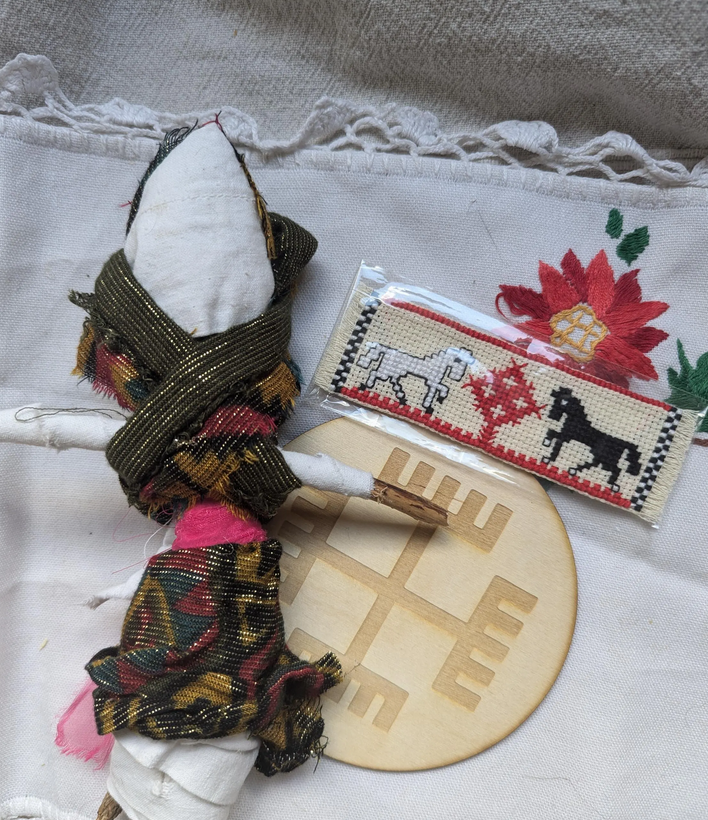
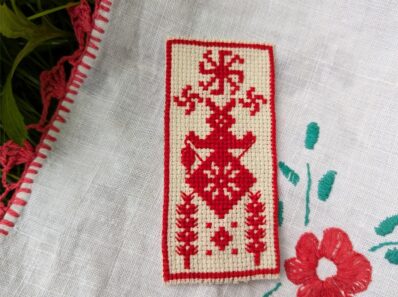
Positive and lucky symbols were quite important for our ancestors
We very rarely say that we bless someone, although we often wish others all the best — and that already means something.
“Hugs,” “warm hugs” — in messages, these are our digital equivalents of actually embracing our loved ones. In the past, people really would hug and embrace each other upon meetings, a gesture still practiced in more hippie-oriented circles and inside close families. Most of us at least send symbolic “hugs.”
Christian or Catholic greetings are rarely used today, but they still appear occasionally. The magazine Niedziela writes beautifully about “Szczęść Boże” (literally “May God give You happiness”):
“It is a human wish directed to God, a response to the richness of human life. It is a profession of faith in God and His Providence; a belief that what we hope for can only be fulfilled by God. That happiness must come from Him. So it draws attention to God and our dependence on Him — a dependence imbued with God’s goodwill toward man. This is the depth revealed by the humble greeting ‘Szczęść Boże.’ Is that a small thing?”
The traditional response to “Szczęść Boże” is “Bóg zapłać” (“God repay you”).
John Paul II said during one of his pilgrimages:
“Let this beautiful greeting ‘Szczęść Boże’ and ‘Praised be Jesus Christ’ never disappear from the lips of Polish farmers. Greet each other with these words, thus expressing your best wishes to others. In them lies your Christian dignity. Do not allow anyone to take it from you.”
Interestingly, this was many decades ago and since then only the elders use these phrases anymore…
Our ancestors have put positive symbols everywhere around them. Here: Sri Yantra Kilim from AllSlavic.pl shop
In the past, people would kindly say “Stay healthy!” at the end of a meeting. Today, maybe a grandfather might still say that to his grandson.
Even the simple “regards” at the end of an email means something. According to the dictionary, it means: “To send or convey words of remembrance and kindness in a letter or through someone.” In the past, people also said “be greeted” interchangeably with “stay healthy,” so it could be taken as a wish for health. Aleksander Brückner’s 1927 dictionary lists together the words: “healthy,” “health,” “to greet (wish health),” and “healthful.”
For fun, people sometimes say “Czołem!” (I bow to You); and in certain circles, you might hear “Czołem wielkiej Polsce!” (“Salute to Great Poland!”). In the past, people would say, “I bow my head to the honor of the land before you,” or at least: “I bow my head and tip my forehead.” (“czołem biję za cześć ziemię przed wami”; skłaniam głowę i chylę czoła”)
Curses
“I once heard of a mother who cursed her children into jackdaws when they disobeyed.” — Krzyżanowski, 1962: 141–142
A stepmother’s curse turned her stepdaughter into a raven. — Gloger, 1898: 61
“To the devil with it!”
“May the devils take it!” (implied: drag it to hell, curse it, etc.).
“To hell! To a hundred devils! Damn it!” — the word czart (devil) comes directly from Slavic mythology.
“May the Licho take it!” “To the Licho with it!” “Evil (Licho) never sleeps…” — Licho is a Slavic malevolent demon, sometimes depicted as an old woman in black with one eye. So such exclamations are essentially curses.
“May lightning strike it!” — we dramatize for fun.
But imagine the despair of someone whose house was actually struck by lightning and burned down. Some claim that this isn’t truly a curse, but a saying from the time when Perun (a Slavic god) was worshiped, and that it survived in Silesian dialects: “idź w pierony!” (“go to the lightning!”), “pieronie jasny!” (“you bright thunderbolt!”), or in phrases involving hurling thunderbolts. It may just as well be linked to myths about Zeus or… actual lightning, so let’s leave that for now.
Very often we throw out phrases in the heat of the moment like:
“I’ll hang myself if this stain doesn’t come out,”
“I’ll kill you if you spill the juice,”
“I’ll die if the train is late,”
“Niech to szlag! – “May a stroke strike you” (schlag from German: blow, strike), …
Sometimes we bluntly say: “I curse you,” or joke about putting a curse on someone. Or we actually try to curse people, like was touched upon in my article about The Internet Witches.
We might say: “Marek cursed: Go to hell!” — and in the literal sense, that is a curse, as in placing a spell.
Some time ago, I heard this: when you say “martwię się” (“I’m worried” in Polish) you’re really saying, “I wish I were dead,” “I want death.” – Chcę być martwy.
I remembered that for about a week and stopped saying it — then I forgot.
Anyway, quite often we’re not cursing others, but painting our own reality with the words we say. We repeat to ourselves daily that we live in a:
damn world,
same old misery,
everything’s shitty but stable,
dirt poor…
Each of us can observe our surroundings and assess how those who speak this way are doing in life.
So:
do blessings and curses work?
“All kinds of bad wishes can be described as so-called destructive formulas — statements that create an undesirable state of affairs (e.g., ‘May you drop dead!,’ ‘May hell consume you!’).” — Curses as an example of breaking taboos (based on Polish, Slovenian, and other Slavic languages), Agnieszka Będkowska-Kopczyk, Language and Culture, Wrocław, 2009
There have also been experiments, like speaking good or bad words to plants or water and observing the results. One such experiment was conducted by IKEA:
It is said that hate speech — sharp and brutal in tone — sends out different vibrations than a sweet whisper or classical music (which we can test ourselves by setting a sweet whisper or heavy metal as an alarm clock sound).
Another empirical example: most people can tell the difference between a cat that has been cursed and mocked daily versus one that’s been well-treated and complimented.
In the end, we should note that we are not slaves to words, so there’s no need to be overly dramatic. Everyone can discover their own meanings. For one person, “you witch” may be an insult; for another — a compliment.