The essence of a blessing is a mother creating a protective cocoon around her child. A cocoon that helps the child avoid misfortunes and directs its actions onto the right path, without wasting energy in vain.
A blessing works independently of distance and is the strongest protective amulet. It is believed that a person blessed by their mother cannot be harmed.
Someone else wrote:
Respect and pray for your men. Bless them every day, every minute.
Or maybe instead of blessing him, you curse him. Sometimes we don’t even realize how often during the day we curse our men – usually in our thoughts. I look at the wall, it’s dirty – he didn’t paint it. I get into the car, it’s dirty – he didn’t wash it. (…)
And then we go out into the world to seek happiness and fulfillment. So I DECLARE: We won’t find it there!
In the 1900 edition of Zygmunt Gloger’s “Encyclopedia of Old Polish Culture,” we read under the entry for “biesiada”:
Biesiada is a cheerful gathering over drinks and food, a feast, honor, banquet, merrymaking, celebration, revelry. The rural people call every family celebration, namely weddings and christenings, in which by the old custom the whole village participates, a biesiada, just as in the past the entire neighborhood would gather in noble houses; for the old custom was common to the entire nation. The term uczta (feast) had a more specific meaning than biesiada, and therefore descriptions of ancient feasts will be presented under this word. Regarding biesiadas, it was said: 1) When you are sitting at a biesiada, don’t think about any quarrels. 2) A biesiada is rare without a jester (Rysiński). 3) A dry biesiada is like being drunk without beer (Knapski). 4) A rich man has penance, a poor man has a biesiada (Knapski). 5) Seven – a biesiada, nine – a quarrel.
Burning candles / Living fire / Eternal fire
The name “znicz” comes from the Lithuanian word “žinys,” which means a shaman or a wizard (someone who knows). Jan Długosz wrote in his chronicle that the Lithuanians had a wizard named Znicz, who guarded the eternal fire in the castle of Świętoróg. Later authors did not read carefully, and many scholars from Kraszewski to Narbutt swore that the Lithuanians burned the holy fire, that is… Znicz.
*BTW Znicz is also a snitch in Quidditch in brilliant Polish translation of Harry Potter. It fits in my opinion.
There they also performed sacrifices to their gods and constantly burned the eternal fire, which they called Znicz, until Jagiełło converted them to Christ, as will be explained below. Polish, Lithuanian, and Ruthenian Chronicle, Maciej Stryjkowski, 1582
Another issue is the so-called “living fire.” Even in the Middle Ages, it was believed that for everyday use, an old, well-known fire lit by anything or smoldering somewhere in the kitchen for a week would suffice, but for rituals or ceremonies, it was worth having a “living,” new fire. Hence the numerous drill holes (shallow recesses) in the walls of some older churches, as the “living fire” is best kindled in a sacred place.
Much earlier in the ancient world, well-known to Christianity, there was a custom of lighting a "new fire" at the beginning of the year (March 1st). According to solar symbolism, this was done naturally by focusing the rays of the sun in a concave mirror or by rubbing the branches of a fruit-bearing tree together. The first method is still successfully used in Greece today when lighting the Olympic flame. In Christianity as well, which celebrates its biggest holiday around the same time of year, there could be no lack of reference to the pre-Christian tradition of lighting holy fires. Easter celebrations began with the Easter Vigil of Light.

Drill holes for fire, Sacred Architecture of Western Pomerania, http://architektura.pomorze.pl/Otwory-po-swidrach-ogniowych+648
Drill holes for kindling the “living fire” can also be found in numerous devilish and holy stones, for example, in Krzesławice, next to Świecie or in Kontrewers. Today, we also ignite everyday, ordinary things from anything, but something more important is usually not from the stove, but somehow more elegantly. And there is also the topic of not lighting cigarettes from a candle because the sailor dies – it’s hard to say why, but actually, lighting a cigarette from a candle practically never happens…
Gate (Brama)
Gates, well, they used to make them a long time ago, they would meet, make gates according to their mood, set up a small table and now they make the gates in a similar way. Somewhere on the road, there is a green gate, well, they greet the newlyweds, offer wine… they make gates anywhere… they made a gate near the river here, and there is another one on the bridge, closer to us… Just recently there was a wedding, so many gates here, one near the church, then here, another one near Ronczek’s…
Słownictwo polSzczyzny gwarowej na BraSławSzczyźnie, Janusz Rieger, 2014
To be honest, I couldn’t find any information on the origins of the custom of making “gates,” but even nowadays, when I drive through some village on the weekend, there it is – a gate…
Gifts
Gifts, depending on the occasion, had different names in Poland: on name days, people gave “wiązanie”, on New Year’s it was a common tradition to give “kolęda”; a gift for good news was called “nowinne”, for finding a lost item – “znaleźne”, an offering for a lord or superior – “poczesne”, for a fiancée – “zalotne”; when returning from a trip or city, people brought “gościniec”. Poles often went overboard with their gifts(…) All historical memoirs and old records are filled with information about gifts that rulers gave to their subjects, lords to kings and queens, and each other.
Zygmunt Gloger, Encyklopedja Staropolska, 1900
Graves
Polish cemeteries and burying bodies. Despite the adoption of Christianity, ancient pagan customs persisted in the nation for a long time, including throwing branches onto graves by passersby.
A pagan would throw a branch so that when the pile accumulated, it would burn with fire, through which the souls of the deceased were cleansed. Having become a Christian, he would do the same for a long time, but with a prayer for the dead on his lips.
Christianity required burying the dead under churches and in cemeteries, usually surrounding the church. It was not easy to overcome old customs, especially in Lithuania and Russia, where there are still non-parish rural cemeteries in fields and forests.
Religia Pomorzan we wczesnym średniowieczu, K. Kajkowski, A. Kuczkowski, 2010
The motif of the river as a symbolic boundary seems to be confirmed by Pomeranian boat burials. Such graves were found, among others, on Góra Chełmska near Koszalin and in Cedynia.
Religia Pomorzan we wczesnym średniowieczu, K. Kajkowski, A. Kuczkowski, 2010
Another interesting fact can be the stele burials in Podlasie.
There are also many burial mounds in Poland.
Greetings
Greetings and salutations. In the privilege of Sigismund I from 1523, the Pogonia coat of arms is called Boże-zdarz and Zdarzbóg. These are words used in Poland, probably since very ancient times, when people meet. It was also said, “Pomagaj-Bóg” or “Pomaga-Bóg” (let God help You). Jan Kochanowski in his satire “To Paweł” writes: “I wanted to say ‘pomagabóg’ to you several times.”
You also hear a lot about the greeting “Sława!” but I don’t know where it came from yet.
“Greening” house in the spring
It should be assumed that the expression of these ancient traditions is also the custom of adorning houses and the entire property with greenery, especially with branches of linden, hornbeam, birch (…), beech (…) and tatarak on these days [Pentecost].
Rituals, Ceremonies, Holidays from Pagan Times to the 20th Century, Leonard J. Pełka.
Magic
The belief in magic spells is deeply rooted in our people: milk spells, love spells, hunting spells, eye spells, healing spells, as well as spells related to droughts and weather.
We have a whole dictionary of words that refer exclusively to spells and incantations. The Polish people use different words to describe the act of casting a spell through the eyes, such as “ozionąć”, “zazionąć”, “zaziorać”, “przekosić”, “uroczyć” and (by blowing) “nadąć”. The concept of casting spells is usually expressed in Aryan languages by the words “to do” or “to make”. The Polish people use words such as “oczynić”, “odczynić”, and “uczynek” to mean spells. When Christianity was introduced to European countries, the role of sorcerers – priests and healers – declined, and what was left was passed on to witches, hags, and nameless beings that were despised by society. In order to give themselves meaning, they often resorted to magical practices and believed in them themselves.
Zygmunt Gloger, Encyklopedia Staropolska, 1900.
Rozpleciny
The custom of UNBRAIDING the bride’s braids before the wedding. This ancient Polish-Slavic custom is described in detail in the work “Wedding Celebrations” by Pruski (pseudonym of Zygm. Gloger), Krakow, 1869.
Roofs
One of the oldest and simplest monuments of the temple type are the small roofed structures scattered throughout Slavic lands and Lithuania, placed above holy springs, over statues and figures by the roadside, as well as small chapels which had to distinguish rural shrines of the past. These chapels, erected on four or only two pillars, sheltered idols, springs, stones from mud and bird attacks. Later, they were used for crosses and signs of the Passion erected on the site of the shrines. Here we also recall fences with gates surrounding sacred oaks.
Józef Ignacy Kraszewski-Sztuka u Slowian, Wilno, 1860
Drought
It is a common belief in Slavic countries that during a drought, water should be replenished. It happened that live animals were drowned in various bodies of water or rivers, their blood was poured in, and even (as was done in Belarus) human-shaped dolls were drowned. (…) In Pomeranian beliefs, it was believed that the predatory bird kania caused drought with its cry. An ritual to counteract this was described more precisely only in the 19th century, called the “cutting of kania”, which takes place on St. John’s Day (…), still cultivated in Kashubia today.
Religia Pomorzan we wczesnym średniowieczu, K. Kajkowski, A. Kuczkowski. 2010
Sacrifice on the stone
Sacrifices on a Stone
In the Czech Republic, traces of these sacrificial sites can be found in almost all towns named after “treba” (sacrifice), such as Trzebnice, Trzebiste, Trzeblice, Trzebin, Trzeboń, Trzeboc, Trzebic, Trzebetice, and others. (…) It seems that in Poland and perhaps in Rus, by following the places named “treba,” which are quite numerous, legends about sacrificial sites and their remains could be discovered.
Art among the Slavs: particularly in pre-Christian Poland and Lithuania. J. I. Kraszewski, 1860.
Strzemienny
The name of one of the oldest Polish toasts comes from the noun “strzemię” (stirrup). “Strzemienny” or “strzemienny toast” is a farewell toast – the last one, drunk at the very end. It is called that because it was raised when the departing person put their foot in the stirrup to set off on horseback.
Narodowe Centrum Kulury, Ojczysty – dodaj do ulubionych
Respect for Bread
When sitting down to a meal, Poles always take off their headgear. If a piece of bread falls to the ground, they pick it up and kiss it as if apologizing for the offense. This vividly recalls the words of the 1674 brochure “Dworstwo obyczajów”: “Why do we kiss the bread we have picked up when it falls to the ground? – Because bread is holy.” On the table of a Polish landowner, in the living room where guests were received, there was always a loaf of bread covered with a white linen homemade cloth or towel. This used to be the case in all the manor houses of the nobility, and it can still be seen today among the peasant class in the Mazovia and Podlasie regions of the Vistula River. In our expressions and proverbs, bread is very often mentioned. — S. Adalberg collected 179 Polish proverbs about bread in the first edition of “Księga przysłów” (The Book of Proverbs).
It is very interesting that paradoxically today many people fear bread like the devil fears holy water because of gluten, calories…
But anyway, even among the youngest, especially in the countryside, respect for bread is common.
Szczodrość (Hospitality)
The word itself is ancient, as one of the Slavic holidays is called Szczodre Gody.
The numerous derogatory, contemptuous or dismissive terms for a stingy person used in the past also testify to the disdain our ancestors had for stinginess as a trait and for a miser as the bearer of that trait: SKĄPIEC, SKNERA, KUTWA, DUSIGROSZ, WĘDZIGROSZ (smokes those coins instead of spending them, to preserve them and make them last longer), LICZYGROSZ, LICZYKRUPA, LICZYGRZYWNA (GRZYWNA was a former unit of currency used in Poland, the Czech Republic, and Russia – in Ukraine, hryvnias, or grzywnas, have remained to this day), MRZYGŁÓD (sits on his money and grinds his teeth with hunger – a stingy person), SMAŻYWIECHEĆ, SZPERKA, KLUKA, and ZMINDAK.
NCK – Ojczysty, dodaj do ulubionych.
Religious Tolerance
When the Germans were using force to convert the Slavs along the Elbe and lower Oder, the Prussians, the Žemaitians and the Lithuanians along the Pregola and the Neman, the Lechitic people, who embodied everything good and bad that the Slavic character had, did not take part in either the Crusades or the sectarian wars. Germans such as Löwenberg in his work “Das enthüllte Posen” and later Jerzy Wagner, who cannot be accused of Polish chauvinism, wrote: “When during the Reformation many Germans were subjected in their own country to the most terrible persecution, they found hospitable refuge in Catholic Poland. Poland had long ago surpassed the most civilized states in religious tolerance. While in France, Molai and Joan of Arc ended up on the stake, when the night of St. Bartholomew and religious wars consumed hundreds of thousands of victims, when in Spain, the religious terrorism of Philip, in Holland, the fanatical executioners of Alba, in England, the bloody reign of Mary – countless sacrifices were made in people, when the Germans burned Hus and even did the same to the ashes of Wycliffe a hundred years after his death – when they still tore themselves apart in bloody religious wars throughout the century – Kazimierz the Great issued a statute of tolerance in Poland as early as 1356 and made Poland a refuge for all those who were condemned to persecution and death in the then-civilized world.”
Zygmunt Gloger, Encyklopedja Staropolska, 1900
Trees
In Ustka, there was a custom of informing trees about the death of their owner. —-
Religion of Pomeranians in the early Middle Ages, K. Kajkowski, A. Kuczkowski, 2010
The missionary activity of Saint Otto also mentioned that he forbade the Pomeranians from laying branches on graves. (…) There is clearly some connection between the tree (…) and the cult of the dead. It is also unknown whether this custom is related in any way to the custom noted in modern times by ethnographers – laying piles of branches at the site of someone’s tragic death to commemorate the place and the deceased person. eligion of Pomeranians in the early Middle Ages, K. Kajkowski, A. Kuczkowski, 2010
And what about the Christmas decorations made of branches?
Temples
Perhaps the oldest and most intriguing monument of this kind, a remnant of Slavic idolatry, is the so-called Polanica Boldy – a monolithic temple in the Indian style, carved out of rock like the old pagodas, or rather, the entire mountain transformed by human hands into a temple. It is not a building as ornate, as striking in its craftsmanship and highly developed artistry as the synagogues in Mahabalipuram and Kaëltasa, in the mountains of Elephant, Kennery, and Salsett, but it has something of that Eastern character and reminds us of those enormous Indian pagodas.(…)
If anywhere, in Polanickie Boldy we see a living trace of the connection between Slavic architecture and East Indian; a trace so vivid, distinct and striking that the eye of a historian and researcher must involuntarily turn to our ancient lineage from the original cradle of humanity, Asia. The earliest mention of pagan temples in Slavdom is a story by the Arab writer Massudy (Memoires de l’Academie de St-Petersb. IV serie, T. II, 1834, p. 319, 321, 340, 358) from the mid-10th century, but even older accounts containing them (in 956-957) would have been easy for the Arabs, who had continuous trade relations with Slavdom from the 9th century or even earlier, as Srezniewski believes. In chapter LXIV of his description, Massudy writes about Slavic temples with an Eastern exaggeration, but not without certain data that can be distinguished from their poetic form. “In the land of the Slavs, there were buildings revered by them. One of them was erected on a mountain, according to the philosophers, counted among the most sublime on earth. This construction was famous for the elaborate way in which it was built; with an arrangement of various kinds of stones, their various colors, openings made at the top and buildings made on it for observing the sunrise…… with precious stones, which were placed here… from the sounds that can be heard from the top of the temple, and from what happens to them (the Slavs) when this sound echoes in their ears. Another building of this kind was built by one of their kings on Black Mountain, surrounded by miraculous waters of various colors and flavors, whose beneficial effects are widely known. There are great shrines in it, exhibiting Saturn, and at his feet, various kinds of ants, black crows, and other similar birds are represented. One can also see there more peculiar depictions of all kinds of Abyssinians and Ethiopians. Another of their buildings (temple) is located on a mountain surrounded by a bay; it was built of red corals and green emeralds. In the middle of it is a great dome, and under it stands an idol… opposite it, there is another… The construction of this temple is attributed to a certain wise man who lived in this country in ancient times.” (Translation by Franc M. Charmoy). The temple in Retra (Rethre), which Thietmar described, looks like this: “There is, he writes, a town in the possessions of the Redjars, called Riedegast, [1] of triangular shape, and having three gates (Helmold counts nine of them), which are surrounded on all sides by an untouched forest and respected by the inhabitants. Two gates of this town are open to all who come, the third facing the east shows the smallest one.” Source: Józef Ignacy Kraszewski, Sztuka u Słowian, szczególnie w Polsce i Litwie przedchrześcijańskiéj, Wilno, 1860
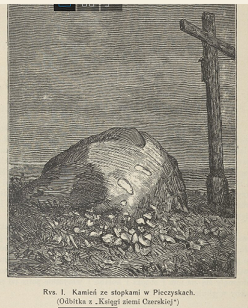
God’s Little Feet
Baruch Maksymilian, Boże stopki : archeologia i folklor kamieni z wyżłobionymi śladami stóp, 1907, polona.pl
One of the sources is the Burchard of Worms’ account from 1024, which prohibits the practice of all magical practices associated with footprints on the surface of stones.
“Religion of the Pomeranians in the Early Middle Ages,” Kamil Kajkowski and Andrzej Kuczkowski, 2010
Compare: God’s Footprints in Statues, Idols, Stones
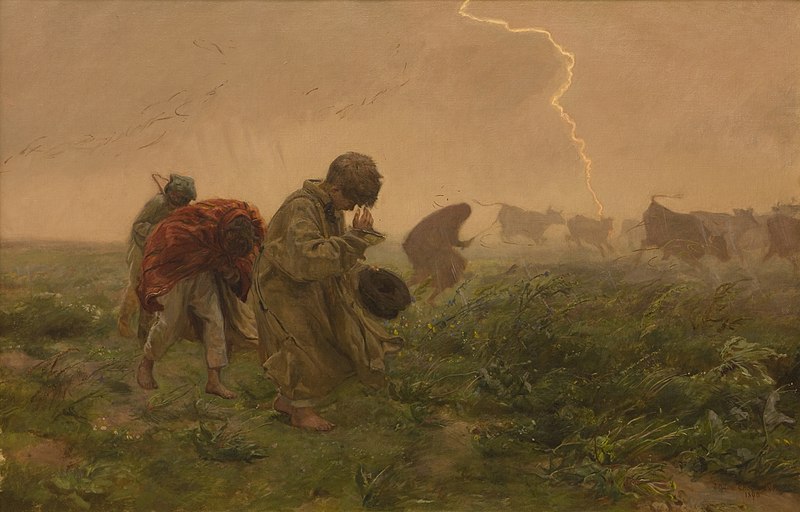
Lightning
Józef Chełmoński, Storm, 1896, Muzeum Narodowe w Krakowie; www.zbiory.mnk.pl ;
Lightning plays a special role in the symbolism of atmospheric precipitation. The place where it strikes is usually considered sacred. (…) Trees that have been struck by lightning are considered exceptional. (…) In 1959, the Polish press reported in a sensational atmosphere that in a certain village in the Rzeszów region (…) no fire brigade was called to a barn struck by lightning. The burning building was said to have been circumvented three times by a naked virgin holding a sacred picture.
“Religion of the Pomeranians in the Early Middle Ages,” Kamil Kajkowski and Andrzej Kuczkowski, 2010
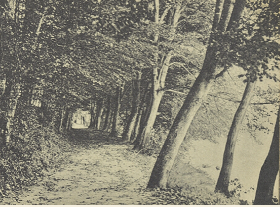
Sacred Groves
Kartuzy, Pomerania, Gaj Światopełka, before 1927, polona.pl
Early medieval accounts attest to the existence of sacred groves in all regions of early medieval Slavic lands. (…) Herbord reported that during his stay in Szczecin [in the years 1124-1128 – ed.] Otto encountered a great spreading oak tree under which there is a favorite spring, the dwelling place of a deity held in great esteem. (…) Ebbo, on the other hand, mentions a walnut tree that the bishop did not cut down at the insistent request of the townspeople.
“Religion of the Pomeranians in the Early Middle Ages,” Kamil Kajkowski and Andrzej Kuczkowski, 2010
Compare: Oak in Fauna and Flora,
Daszki in Customs, and “Sacred Groves of the Prussians and the beginnings of the cult of the Mother of God in Święta Lipka,” published by the Sanctuary of the Mother of God of Christian Unity, Święta Lipka, 2020 in “How to Find a Pagan Place of Worship in Poland (as an example)?”
Haircutting Ceremony
Postrzyżyny. The oldest of Polish chroniclers, Gallus, mentions briefly the haircutting ceremony of the Piast prince Semovit’s son and then the feast at Ziemomysł’s, during which his seven-year-old son Mieszko (Mieczysław I) regained his sight. Although Gallus did not mention anything about the haircutting ceremony at this feast, all later chroniclers, such as Kadłubek, Mateusz Cholewa, Długosz, and others, describe Mieczysław’s haircutting ceremony based on speculation. Recent historical research by Brückner questions whether there was actually a pagan rite of passage involving a haircutting ceremony among the Lechitic people, for which there is insufficient evidence. According to Lelewel, during those times when property rights were not properly established, the father introduced his son solemnly and declared him his heir through the haircutting ceremony.
Zygmunt Gloger, Encyklopedja Staropolska vol. II, Warsaw, 1900
Drinking at a Wake
To calm down the soul of dead they would eat kutia and drink beer after the funeral. Beer would also help with family’s tears and grief. Even to this day getting drunk at a wake calms down the one who have passed away. Rest in peace! – we make a toast this way.
„Wiara Słowian z obrzędów, klechd, pieśni ludu, guseł, kronik i mowy słowiańskiej wskrzeszona, 1880
Worth noting that getting drunk at a wake is not Slavic invention. There is no American movie where they don’t drink a lot after the funeral.
Sailing
One might think that Slavs, like hobbits, don’t swim. Here is an article in Polish arguing to the contrary :