
Hair? Why hair? Well, because in the clothing section there are a lot of head coverings and hairstyles, so I thought it would be better to include them here.
Braids
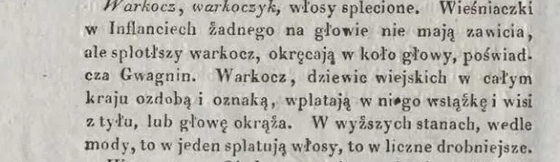
Łukasz Gołębiowski, Clothing in Poland from the earliest times to the present day, Warsaw, 1830
Braids, also called ‘kosa’, hair braided by virgins, are the most accurate decoration of their heads and a symbol of their virginity, with a red ribbon woven into the end of the braid. Polish virgins always braided their hair into one or two braids, which either flowed down their backs or circled around their heads. At the wedding veil ceremony, the bride’s braid was cut, leaving only the “kędry”, because it was not appropriate for married women to wear and fiddle with braids, but to permanently tuck them with a hem. The braids were also cut off for the girls who lost their wreath. Hence, before the wedding, the braids were undone to show the world that they did not have cut hair.
Zygmunt Gloger, Illustrated Old Polish Encyclopedia, Warsaw, 1900-1903
Braids, specifically like those worn by Julia Tymoshenko, are also part of the national dress of Ukrainian women:
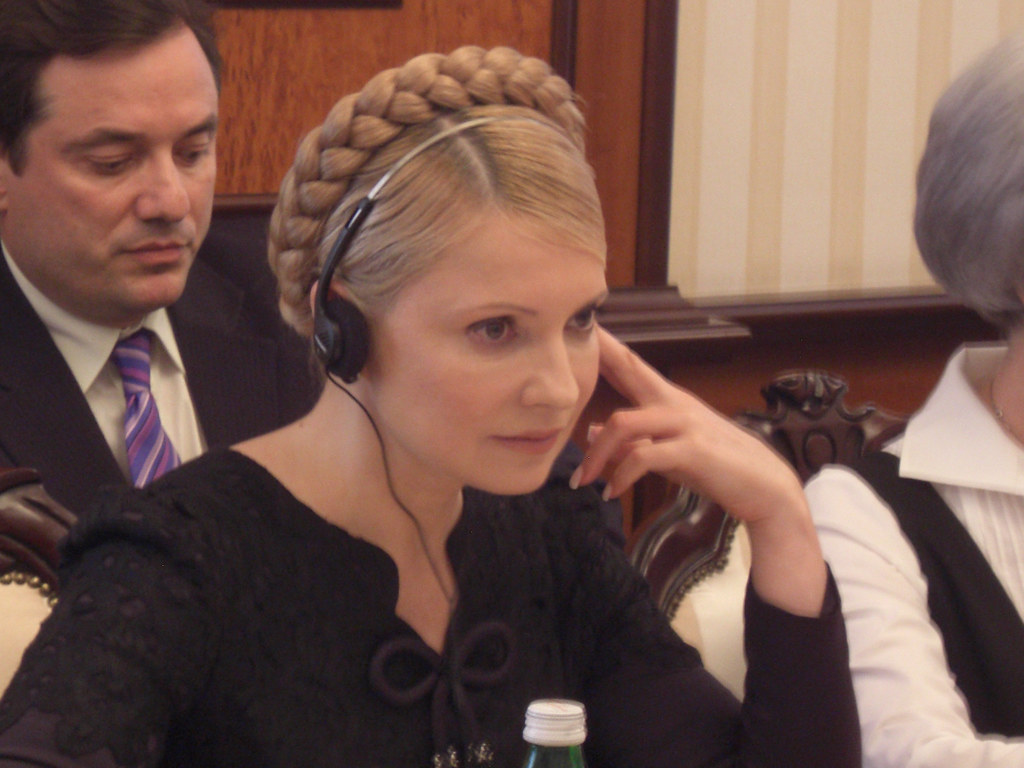
A child or a young girl would wear two braids, while a mature woman can only wear one (see: porn).
a Cap
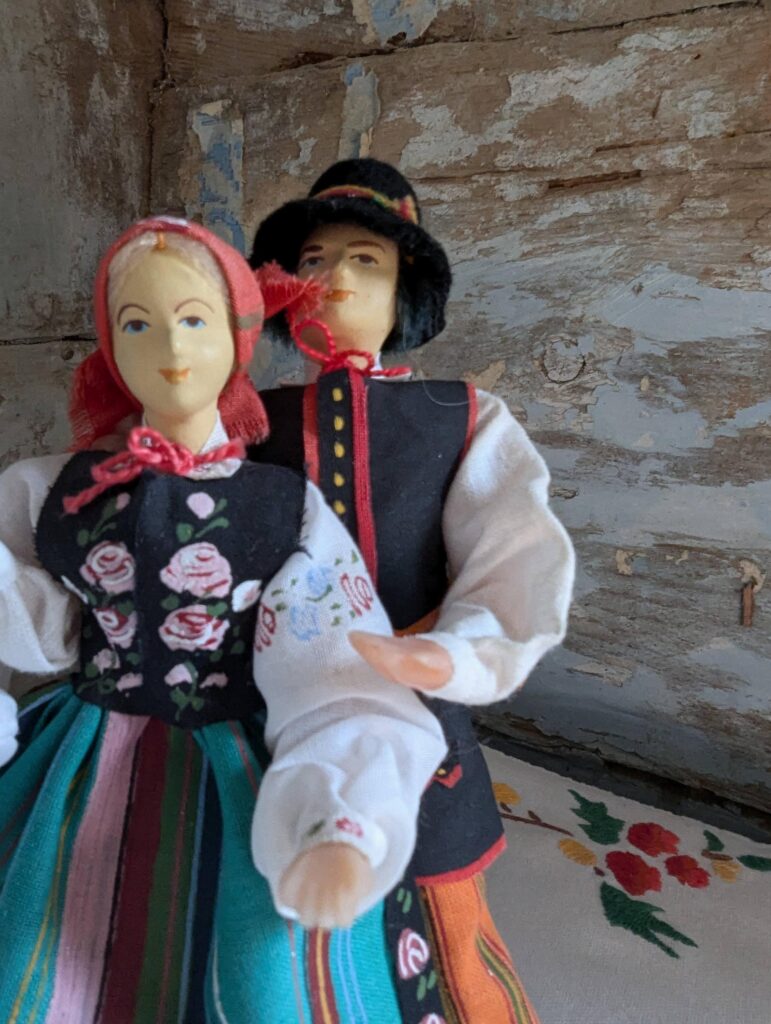
Just as a wreath on braids or loose hair was a symbol of virginity and could only be worn by maidens, so a white cap, covering cut hair, was a sign of a married woman.

 The "oczepiny," or the first time a married woman puts on a cap after the wedding, is one of the most important rituals of a Polish wedding.
— Zygmunt Gloger, Illustrated Encyclopaedia of Old Poland, Warsaw, 1900-1903
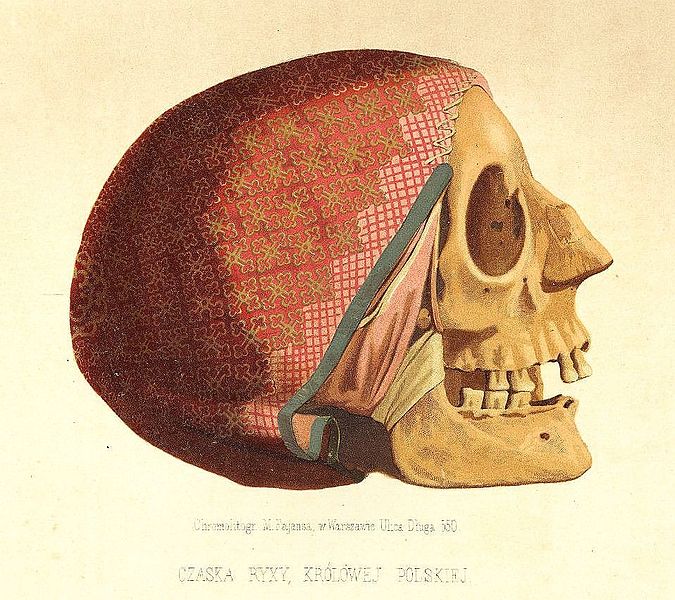
Queen Ryksa’s skull, 995-1063
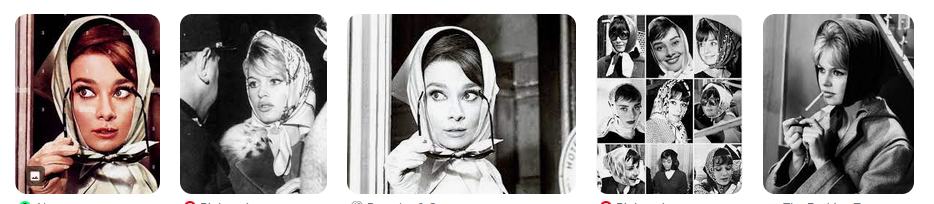
A sort of scarf on a women’s head would be a symbol of babushka in particular and Eastern European stereotypical women in general, but honestly, did You know, that like 70 years ago even in the West women would generally cover their heads with same sort of shawl? Just look:
a Hat
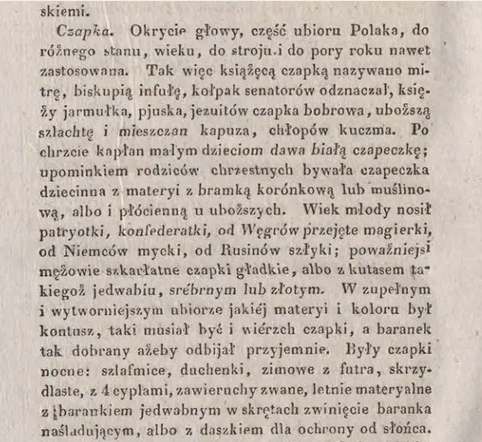
Łukasz Gołębiowski, Costumes in Poland from Ancient Times to the Present Day, Warsaw, 1830
a Comb
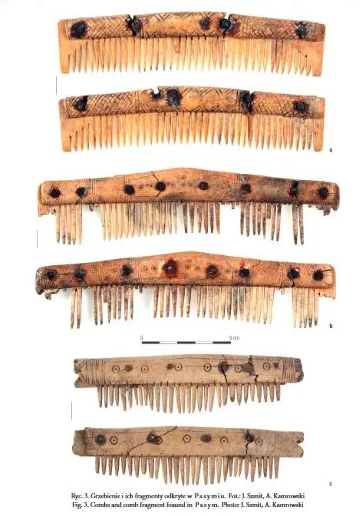
Unusual combs from the 8th century found in Pasym, in: SŁAWOMIR WADYLCIEKA, EARLY MEDIEVAL COMBS FROM PASYM IN THE SZCZYTNO DISTRICT, Archaeological News, 2018
Other hairstyles
In the Polish language, among the terms related to the way of combing hair, we have just as many native words as borrowings from various languages. So we have the Slavic CZUPRYNA and GRZYWKA, native KĘDZIORY and KOSMYKI, Czech PUKIEL (Czech pukla) and German LOK (German Locke), Italian FIOKI (Italian fiocco) and French ANGLEZY (French boucles anglaises), and finally WARKOCZ with completely lost etymology (perhaps a very old borrowing from Old Turkish örküč 'braid')...
National Centre for Culture, Native – add to favourites
Kołtun
There is a stereotype that in the olden days every Slav would have uncombed, matted hair named kołtun, contrary to nicely polished Germans or French. But was it true?
Since I came to this country, I have been interested in a certain local phenomenon, known in the world, but here exceptionally widespread, so that it was enough to walk along the poorer streets of Warsaw to see it on people's heads - polonica, kołtun, as they are called here: a strange structure made of twisted, matted hair in various shapes, sometimes of side strands, sometimes of a hairball, or a braid-like thing resembling a beaver tail. It was believed that this dreadlock was full of good and evil powers, so its owners reportedly preferred to die rather than get rid of it.
Olga Tokarczuk, Bizarre Tales

Dreadlocks (from dread, i.e. swaying of hanging braids), plica, trichoma, commonly but quite wrongly called plica polonica, because Rosenbaum, relying on classical works by Grimm ("Deutsche Mythologie") and his own, has proved that the phenomenon called kołtun has been known among the Germans for centuries, along the Rhine, in Bavaria, and so on, and has spread from west to east, not the other way around.
— Zygmunt Gloger, Illustrated Encyclopaedia of Old Poland, Warsaw, 1900-1903
Crowns of Russian princesses
You can’t mistake it for anything else. I think I only see it in old Russian fairy tales or on the packaging of exquisite tea or shampoo. If you see such a headpiece anywhere, the association is one: a Russian princess from a fairy tale.

TBH if I was Russian I would wear it 24/7, especially if I would run for president or Miss World or something. No?
Hairband
I have to admit, I have no idea where this one came from but you have to admit that a classic hippie Slavic hairband appears everywhere from ‘Stara baśń’ to ‘The Witcher’, so somehow it works. In esoteric circles, it is said to be a protective headband, but where did this belief come from?
It’s everywhere yet when I look for it I can’t find it, it also doesn’t have any name (I hear in Russia, it is apparently called ‘oczelje‘). Do You even know what I am talking about? This:
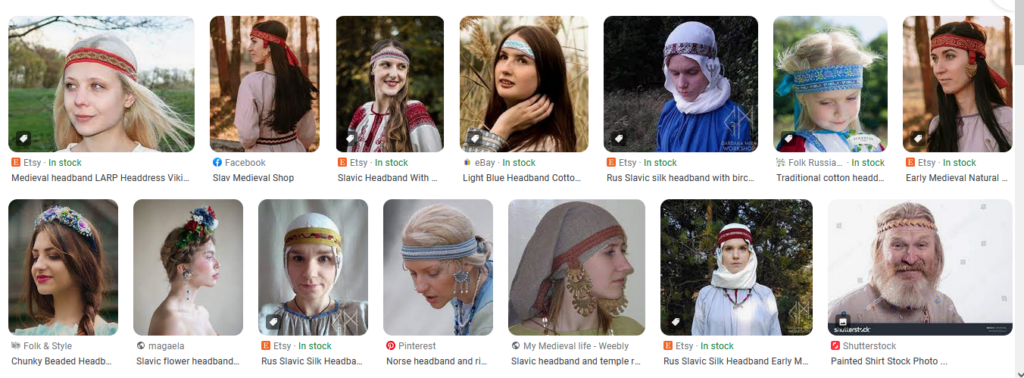
More on red protective bands and rims around head and forehead on our blog.
Tatarak
[Włosy] myli raniej ajirami, ajirau wo takie w stawku,
takie, wiecie, ajiry rosno, wot tych ajirów korzeniów
Vocabulary of the Polish dialect in Brasław, Janusz Rieger, 2014, https://depot.ceon.pl/bitstream/handle/123456789/16343/9788364003295_interior.pdf.pdf?sequence=1&isAllowed=y
Wreath
It is actually a symbol of Slavic women.
Here is an article in National Geographic with amazing photos of flower and wheat wreaths from Ukraine for inspiration.
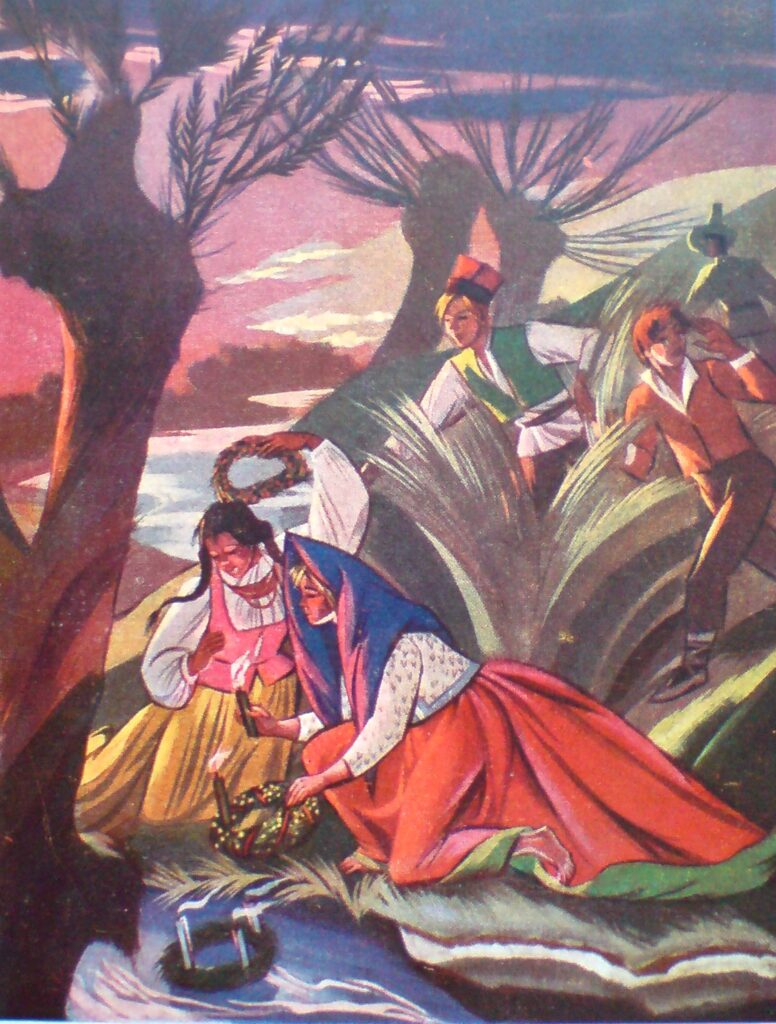
Zofia Stryjeńska, Wreaths
Wreath of Myrtle
Braidsmades would twirl a wreath of myrtle.
Vocabulary of the Polish dialect in Brasław, Janusz Rieger, 2014
Interestingly, the myrtle wreath is still popular as a head decoration in Poland when girls are around 7 and dress up for church event called Komunia.