I know in English-speaking world there are many questionable books on slavic history and gods, mostly from people who have never even been to any slavic country and know nothing first-hand. Having said that, if You know any slavic language, You can rest assured that there are many very good publications in Polish, czech or Russian, dating back to 1800s or even further then that. Which are my favourites and which are not?
Least favourite books on slavic pagan beliefs
Życie erotyczne Słowian, Tomasz J Kosiński, 2021
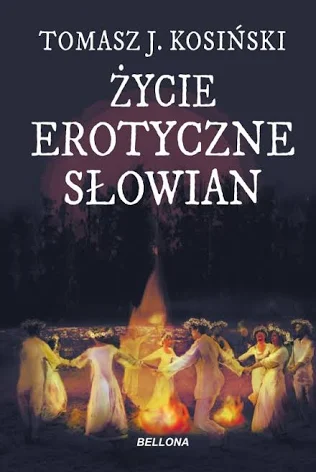
The book was clearly written out of love for the author’s wife. At times it was interesting, I jotted down a few things, and some ideas were new to me, but certain observations keep repeating over and over. And if I read one more time that the earth, like a woman, is moist and fertile, as reflected in agricultural-love rituals, I’ll
Tomasz Kosiński, Słowiańskie skarby. Tajemnice zabytków runicznych z Retry, Bellona, 2018
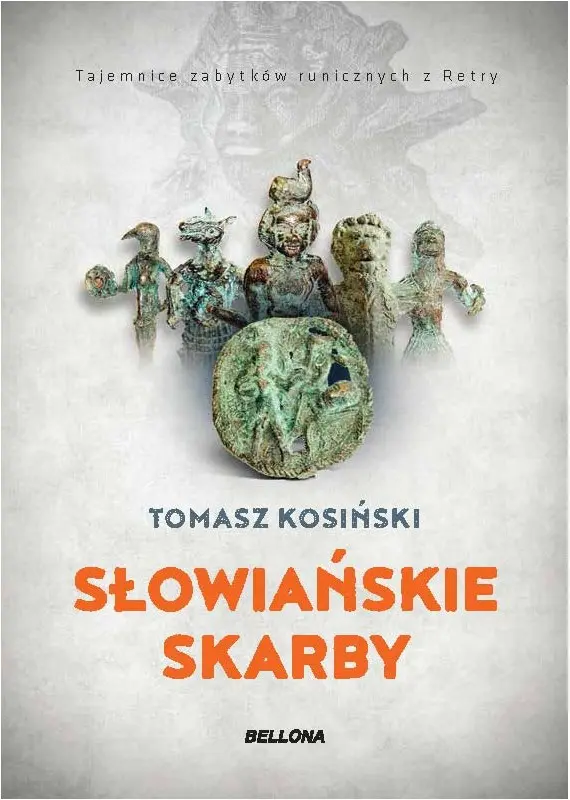
Anyone interested in things like slavic statues and idols quickly comes across the so-called Prillwitz idols. But just as quickly, they move on and leave them behind—because even the turbo-Slavs like Tadeusz Wolański were already dismissing them back in the 19th century…
More: 4 uneasy truths about slavic native faith and paganism
But it’s not just about that. These figurines have something about them that just instantly makes you feel someone tampered with them (a comical god with a goose on his head taken from some medieval engraving, Greek-style figurines, a Baroque-style medallion—all of it smeared with ‘runes’ from head to toe).
Tomasz Kosiński starts off well, describing the history of the discovery and the reactions of scholars and historians from ancient times to the present. But then he adds a ‘but…’ and begins to meticulously describe every nonsensical figurine, throwing in interpretations that throw into the mix yet more, possibly hundreds more, deities—like a goddess… named Water. Someone really needs to write a separate piece about how Slavic deities keep multiplying—seems like a dozen more pop up every year, and with AI it gets even more surreal.
Anyway, the book ends with a vague conclusion that, while research shows that most of the figurines and vessels may be fakes, it all still needs to be researched. And now imagine that: unless 200 samples are taken from each object, someone will always be able to say that nothing’s conclusive yet… And if any one spear or plate tangled up in this whole collection turns out to be genuinely old, suddenly we’ll have a fresh wave of theories trying to validate the other 199 fake artifacts.
On the plus side: unlike Janusz Bieszk, Tomasz Kosiński provides rational, clear footnotes, his book has no editorial errors, and he actually traveled to the site to see and photograph the figurines himself—which, these days, is already something. It’s also a quick read.
Bogowie Słowian, Tomasz J. Kosiński, Bellona, 2019
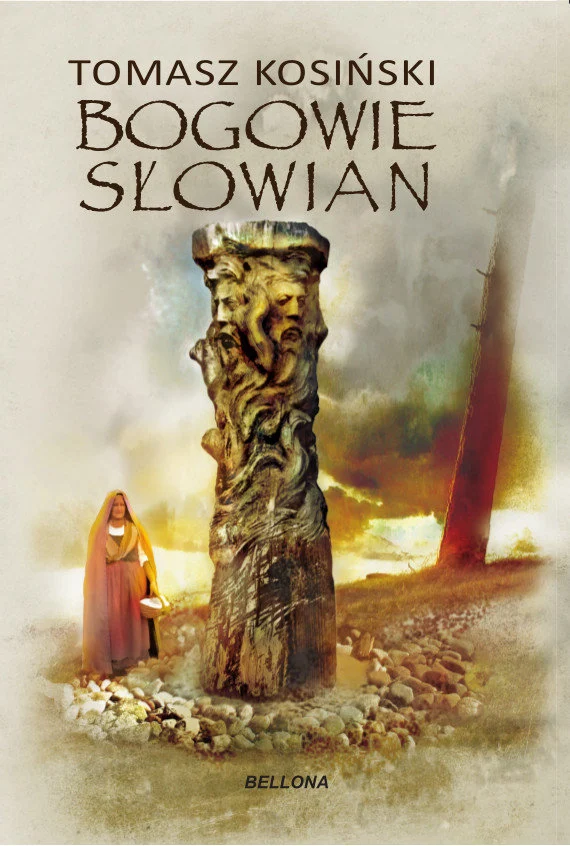
In this book, you’ll find mentions of what must be hundreds of gods, and on top of that, hundreds of their variants… There are also some heroes and various creatures that aren’t exactly relevant.

It’s hard to remember anything out of the book, and I still don’t know which Slavic deities truly ‘existed’ and which didn’t. On one hand, Kosiński cites chronicles, which is really interesting. On the other, he seriously relies on the so-called Prillwitz idols as evidence—specifically those from Jan Potocki’s collection, which Kosiński himself admitted in his own book on the subject are almost certainly fakes…
Here’s a small sample of the whirlwind of associations the author falls into—dragging along a confused reader:
In Koźmińczyk’s Postilla from 1405, among other Polish gods, an unknown ‘Qui’ is mentioned, who can supposedly be linked to Kuj—the divine blacksmith, Svarog. From Kuj (the smith) we supposedly get the name Kujawy and the dance ‘kujawiak’—with foot stomps echoing the blow of a smith’s hammer.
This same Qui/Kuj shows up at the end of the book as Kij—the mythical founder of Kyiv—who in the next paragraph morphs into the Armenian Kuar, who on the very next page arrives from India, only to transform into Saint Karapet… It’s incredibly hard to keep track of and even harder to take seriously.
There are also small inaccuracies, for example: in the church at Lipnica Murowana, there is not a ‘4.5-meter pillar with four faces of Świętowit.’ What’s there is a pillar said in local legend to have once stood in a pagan temple before the church was built. Incidentally, recent carbon dating studies show that the pillar dates back no earlier than the 15th century. That doesn’t necessarily disprove anything—it could be a copy of an older, destroyed pillar—but we shouldn’t be building worldviews or books on hearsay.

Fenomen Wielkiej Lechii, Tomasz Kosiński, Bellona, 2021
There is one interesting idea in the book, which I’ll present right away:
We tend to think that Lechite or ‘Turboslavic’ theories are a recent phenomenon. Those more in the know are aware that the same themes were explored as far back as the 19th century by Lelewel, Potocki, and Wolański. Tomasz Kosiński collects all such historical references. It turns out these theories have existed virtually since the beginning of literacy in our region, with mentions from 8th-century Arab travelers, 12th-century chronicles, texts by Kochanowski on the subject, and poems by Mickiewicz and Słowacki. So this knowledge has always existed alongside the official narrative. I can imagine a similar book by another author—published, for example, by Czarne publishing house—that might win awards and critical acclaim (though it would likely require an unbearably mocking tone, because apparently that’s the only acceptable way to address such topics).
The second part of the book—seriously—delves into… blog posts. And not scholarly ones, but things like tajnearchiwumwatykanskie.wordpress.com… Copying entire paragraphs from blogs doesn’t take much effort, which may explain why dozens of pages are devoted to them. Then it gets even stranger: the author suddenly begins discussing the profiles of Jerzy Zięba, Justyna Socha, and Wojciech Sumliński, who have nothing to do with the subject. We are presented with the views of unrelated public figures on topics like vaccines, Act 447, Michalkiewicz… The final section covers modern albums and films about the Slavs or so-called Lechia—something that could easily fit into a single article.
Tomasz Kosiński draws on many different disciplines, but his linguistic interpretations are by far the weakest. Based on guesses and associations often only clear to the author, they can go on for pages and look like this:
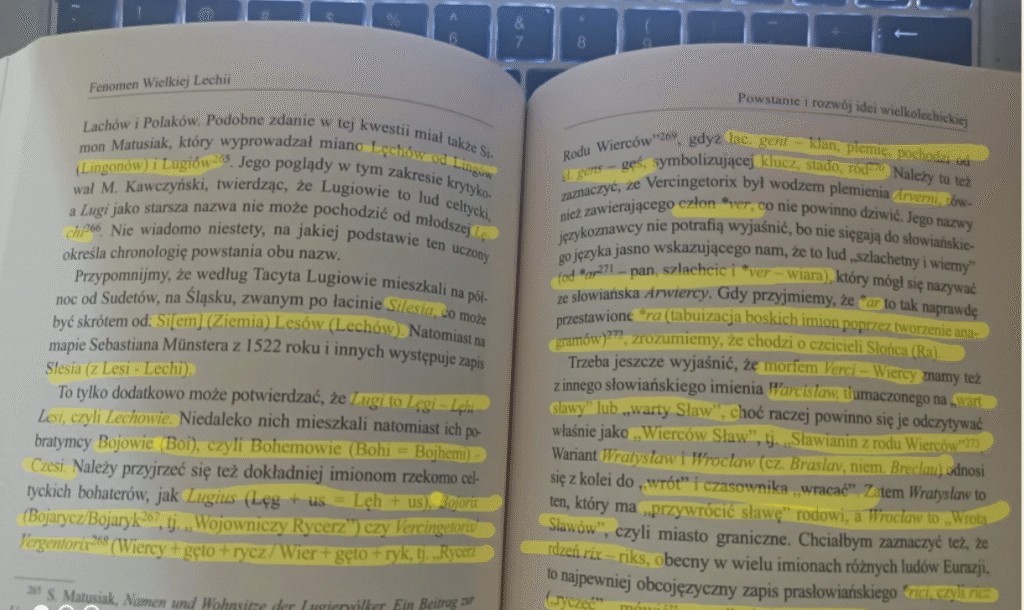
And so, from the Lechites, we hop-skip-jump our way to the god Ra…
Most favourite books on slavic pagan beliefs
Leonard J. Pełka, Polska Demonologia Ludowa, 1987
This book is a quick read, and just about everyone will learn something new from it. It’s based on interviews conducted with people in the post-war period. At times, it’s a wild ride that takes your breath away, and you find yourself thinking: So that’s how it was…
I found it fascinating because alongside familiar things like the Południca (noon demon), it also touches on topics like weather control, or the completely unknown-to-me fact that in villages near Lublin, there were stories of a man dressed in black occasionally descending from the clouds… Pay attention to how the things people talk about in this book sound like tales from 1000 or 100 years ago—but it was the 1980s. Would there even be anyone left to ask today? 🙁 So at the very least, let’s read about it.
Leonard J. Pełka, Rytuały, obrzędy, święta od czasów słowiańskich po wiek XX
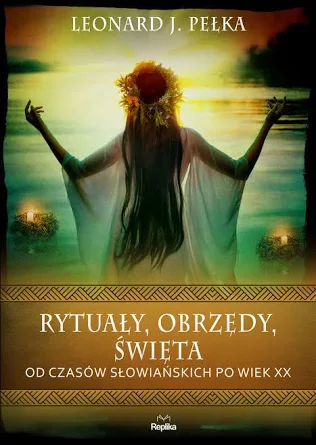
Since I already knew a bit about the basic Slavic rituals and ceremonies, what I found most interesting in the book were the details—for example, that during Kupala Night one could gird oneself with mugwort, or that the bride and groom would be seated on a wolf’s skin. The main holidays are described fairly reliably, but this is definitely not a book for advanced readers. For instance, there’s nothing about the burial of the arrow in Belarus, or about the various strange ancestral traditions like the Żywiec dziady, Śmigus-related customs, Bulgarian Kukeri, or the Hungarian Larp Golem—all of which share a common thread. You can easily start with this book, especially since it can be read in about four hours, but it doesn’t exhaust the topic.
A separate curiosity is the frequent references to socialist holidays and Marxist theory. The book doesn’t state when Leonard Pełka wrote it, but it’s assumed to be during the PRL (Polish People’s Republic) era. Some parts can still be related to the present day, while others simply show how quickly artificial holidays are forgotten (the author wrote extensively about Bookstore Day, Pioneer holidays, 1st May Day celebrations—all of which have now turned to dust).
Łukasz Łuczaj, Dzika Kuchnia
This isn’t strictly a book about the Slavs, but it’s about eating wild plants found in Poland, so the topic does come up. There are also plants that are still eaten or used medicinally only in places like Belarus, Ukraine, and Romania, so anyone interested in Slavic diets is unlikely to be disappointed.
Hanna Lis, Paweł Lis, Kuchnia Słowian,czyli o poszukiwaniu dawnych smaków
When we think about what our ancestors in the early Middle Ages ate and drank, two things usually come to mind: meat and beer. But the menu of the early Slavs was much more diverse! Hanna and Paweł Lis were the first in Poland to attempt a reconstruction of early medieval Slavic recipes and flavors, drawing on both their own experiments conducted at the Żmijowiska settlement near Kazimierz Dolny and on ethnographic, historical, archaeological, botanical, and herbal studies. I have this book, and it’s really great—I use it often.
Kultura Ludowa słowian, Kazimierz Muszyński
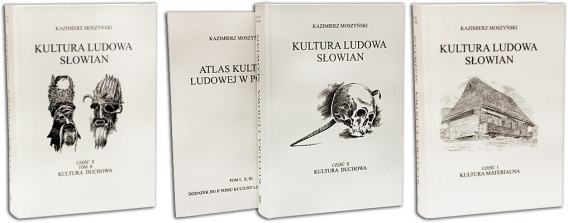
It doesn’t sound like the source on Slavic paganism, but on thousands of pages You can find a lot about our ancestors wearing horns, having a belief system around stars or sacrificing bulls on st. Jura day, which is traditionally connected to Perun. And no, not in 1000s but in, like, 1800s or even 1900s. I go back to this book often for reference about various slavic holidays or beliefs.
Religia Pomorzan we wczesnym sredniowieczu, Kamil Kajkowski
I got this book from a friend and learned quite a lot from it. I liked it and often refer to it here on the site. Thanks, Marek!
Most enigmatic books on slavic pagan beliefs
Diana Jakubowska, Rafał Jakubowski, Wierzenia Slowian i Indoariów, Praźródła, 2019
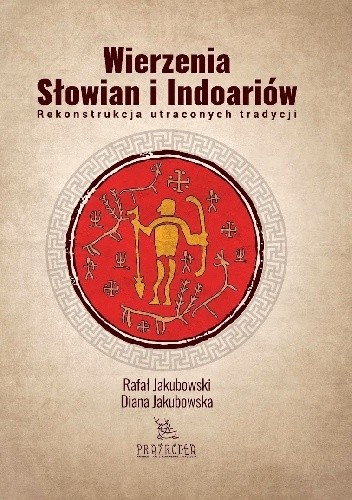
Very cool book that I don’t agree with:)
The main focus of the book is a comparison—though for some reason, specifically between the Bon religion and Slavic beliefs. As it happens, I’m not only interested in Slavic traditions, but I also grew up among Buddhists, studied Tibetan for two years in India, attended Bon courses with my mom (who translated them), and I even have a stupa in my garden, consecrated by Desi Rinpoche—so that topic is close to my heart too.
My main critique of the book is this: when we see analogies between myths, phenomena, or beliefs from Japan, the Asia-Pacific region, or North America and those of the Slavs—what’s more likely? That we all have common Aryan ancestors… or that some things are simply so fundamental and universal that many cultures arrived at similar conclusions independently? In my view, many similarities can be traced back to a shamanic core that exists in belief systems all over the world. And I have evidence! The earliest preserved shamanic relics or cave paintings showing “shaman trips” (e.g., Guizhou, China; Dharung people in Australia; Trois Frères in France; Tassili, Algeria, and many more) are between 5,000 and 30,000 years old. Even under the broadest definition, Indo-Aryans came later—both chronologically and geographically. This is hinted at in the book, e.g., in the part about universal knowledge of the elements.
So, on one hand, the book limits itself geographically, which forces it to ignore some obvious links (like the rain rituals of Śmigus-Dyngus and Balkan Dodola, which are nearly identical to rain-invoking rituals in India, among Kurds, in Central Africa, North America, etc.—which I’ve written about; or universal knowledge about death rituals and agricultural calendars…).
We don’t learn, for example—something I just found out from Wikipedia—that a swastika nearly identical to the one in Kruszwica adorns a church in Ethiopia (both from the 12th century) and that swastikas appear in Ghana too. Why not mention that, if this symbol is our Aryan yin-yang? The observation that swastikas are also found among Native Americans is brushed off with a vague “maybe ‘ours’ reached there too.” That’s possible, but if so, it deserves more than a single footnote. There’s even that fascinating story of Karmapa visiting the Hopi in the 20th century and recognizing them culturally as kin (a connection that’s quite visible). North American tribes had contact with South American ones—so why not investigate if Amazonian shamans have retained similar ancient wisdom or symbolic systems? Some cultures had no contact with the outside world until recently—wouldn’t it be worthwhile to check whether they also developed similar funeral rituals, initiation rites, myths, healing ceremonies, symbols, etc.?
At the same time, the rich and well-documented Aryan connection on the Indian side is only superficially explored in the book. You won’t learn from the book that people in South India, like those in Kujawy (Poland), draw sacred sand patterns in front of their houses; or that Lithuanian is the language closest to Sanskrit; or that the word Budda (awakened) in Polish sounds like budzi się (“is waking up”). On the other hand, the Tibetan Gesar (here spelled “Gasar”) and the Zoroastrian Garshaspa, two entirely different characters from different cultures, are mashed together just because their names start similarly…
If a folktale from the East is only slightly similar to a Polish one, but ends very differently, we’re told it was “probably censored during Christianization.” And yet in another scholarly work, I’ve read about connections between Iranian dragon-slaying myths involving sulfur and the Wawel Dragon in Kraków—or the legend connecting Babel and Wawel, and here there is nothing on this clear and apparent connection.
Every boar, from Japan to Germany, becomes an Indo-Aryan boar. A ritual arrow in Bon becomes a Polish Easter palm. But in reality, Catholic palms are a very recent invention—maybe a century or two old—and their colorful ribbons are rare and not necessarily in the described colors. Traditional palms, like those still given out in rural Orthodox churches, are just willow branches. These are later planted in the soil so they can grow into willow trees—an ancient, beautiful symbol, but unrelated to the book’s thesis. In the Beskid Żywiecki region, people used to smoke the household with the palm. I’m not saying there’s no grain of truth here—but such analogies can’t be made in a superficial or forced way. If you visit a Tatar yurt in Kruszyniany, the yurt itself and the mounted archery competitions with acrobatics are practically identical to what we see in documentaries about Tibet or Bhutan—so much so that they could serve as movie props. Yet none of that is in the book—instead we get vague suggestions of similarities between Bon archery rituals and obscure Polish traditions so niche I can’t even name one.
If we think a horn in the hands of a Slavic deity, a Tibetan vase of prosperity, and a Persian cup are all the same thing—then every other ritual bowl, cup, or chalice could be “linked” too.
There are also some linguistic comparisons. Svarga, swaćba, and świat are romantically grouped as coming from the same root because “from the primal unity emerges Svarga (…) the fusion of five elements…” But then obvious counterexamples like swary (quarrels), which mean the opposite of unity, are conveniently ignored. In many places, the authors refer to Tibetan terms supposedly connected to Slavic concepts. Drawing on my two years of Tibetan study in India, I can honestly say I encountered only two words that loosely reminded me of Polish or Russian: pachleb (“bread”) and metok (“flower”—Russian cvietok). I think that’s about as many as you’d find in any two random languages. Sanskrit is much closer. The book gives a detailed rundown of Bon deities—but fails to find any strong analogues to Slavic deities (aside from vague ones, like gods of the earth, wind, snakes, etc.—but those are found in all mythologies, from Aztec to Hindu).
Meanwhile, Lithuanian gods are called dievas, and Indian gods devas. In old books like Theodor Narbutt’s from 1835, you’ll find tons of parallels between ancient Lithuanian and Indian beliefs. Isn’t that a more fruitful topic than forcing analogies where there are none? The authors casually describe secret practices like Dzogchen and even share esoteric Buddhist instructions, even though that’s not really relevant to the topic—unless we seriously entertain comparisons between Bolesław the Wrymouth’s battle frenzy and the Tibetan tummo practice or Shaolin martial monks… (why not compare it to Joan of Arc’s trance states or Aztec warrior rituals, then?).
After all, Dzongsar Khyentse Rinpoche has already warned against freely sharing such teachings in his famous post:
“Some people seem to find it fashionable to hang words like ‘Dzogchen’ and ‘Mahamudra’ in their mouths. If you have received profound instructions, it is good to follow those instructions and keep them to yourself…”
Here’s a personal question I wish the book addressed: Why do Tibetans eat faworki (fried pastries) during their New Year in February, just like we do on Fat Thursday in… February? This is based on my own observation, but unfortunately, I didn’t find any answer to it in the book.
So what did I like about this book, since I’ve been so critical?
As you can tell from my impassioned review—I definitely wasn’t indifferent while reading. It didn’t bore or discourage me, but rather sparked my own reflections (something that rarely happens these days).
The universality of customs, archetypes, and stories is something I feel deeply and find incredibly inspiring—and this book gave me a lot that completed my inner puzzle. I appreciated the broader spiritual reflection (even if not always tied to the main topic)—that traditional culture, folktales, and rituals are an antidote to the shallow, idiotic Western mindset. I feel the same way.
I also liked the final thought: since we know almost nothing about our ancient culture, we have to make an effort to find out—without arguing over details. As the authors themselves put it: “this is important for each of our personal development.”
There were plenty of such reflections, intriguing associations, and insights throughout the book. That’s why, despite everything, I took notes and plan to use them in future articles for this site—and overall, I did like the book. 🙂
P.S. There’s a fantastic book called The Encyclopedia of Tibetan Symbols and Motifs. It’s brilliant, deeply inspiring, and thorough. It would’ve made great prep material before writing any future, revised edition of Beliefs of the Slavs and Indo-Aryans. Or who knows—maybe I or the authors will someday feel inspired to write a similar encyclopedia of Slavic symbols?
Głagolica, Tadeusz Pruss Mroziński, 2019
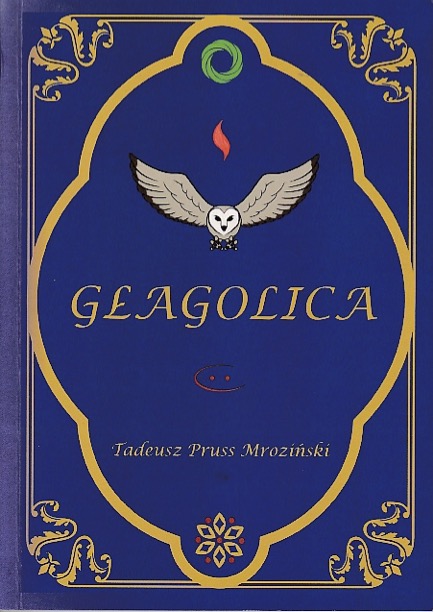
Listen, think of me what you will, but I bought this book myself and I like it. I don’t know Tadeusz Pruss, but for something self-published, it looks great graphically—it kind of leans toward Grzybog in terms of that fun, out-there vibe. And the content? Well, if Glagolitic is an ancient, sacred language, and the polka dot pattern isn’t just dots but the matrix of the universe—then everything checks out. There’s also a second volume.
Janusz Bieszk, Słowiańscy Królowie Lechii, Polska Starożytna, 2016
After the author’s promises, I expected a lot. But inside…
It starts with the author presenting over a dozen different lists of Polish rulers from before Mieszko (BTW You can buy books on them here), taken from various sources. Each list is completely different, so instead of dropping the matter or focusing on a common thread, Mr. Bieszk compiles his own mishmash from these versions and claims that everything is now indisputably clear based on these ‘proofs’.
Then comes the part where he clings, as we say in Poland: like a drunk to a fence; to every town, river, or mountain in the world that contains anything resembling: Lech, Lach, etc. As you can imagine—there are plenty of such places. For example, Leh in Ladakh. Naturally, all this supposedly proves that ancient Poles were living there. I was also annoyed by a section in which the author writes in a conspiratorial tone about how there’s a ‘secret’ gallery of ancient Polish rulers hidden by the Church somewhere in the sacristy at Jasna Góra, and no one wants to show it to him. It sounded dramatic! So dramatic that I googled ‘gallery of Polish rulers Jasna Góra’—and of course, it’s not secret at all.
There are many such gimmicks throughout the book—something allegedly can’t be shown for unexplained reasons, so it’s redrawn or paraphrased, which doesn’t help the book’s credibility. For example, writing about sensational Lechite coins would be fine—if there was at least one photo.
Overall: I appreciate the author’s effort, and I do believe there’s a grain of truth in this subject, but not everyone will have the patience for this book. One could ask whether such a loose approach to sources (titles and links dumped at the end of the book without references or page numbers, and worse… sources include YouTube videos XD), to evidence (his own trip to a site supposedly yields more accurate conclusions than academic work), to translations (we’re supposed to just take J. Bieszk’s Latin translations on faith…), and to illustrations (as we know—a single photo explains more than a thousand words), actually helps or harms the discovery of Slavic history.
That said, I do own several of Janusz Bieszk’s books, and this one is probably the most interesting and best-documented of them all…
——-
Would You like Your book to be featured here or in my shop? Contact me:)