Before you dismiss me as a crazy Slav in a long flaxen dress, let me reassure you right away—
I’m writing this in leggings.
But let’s go back for a moment to the times when leggings didn’t exist.
What You’ll learn here:
How the heck could slavic clothing protect Your energy?!
What is the oldest known Slavic piece of clothing?
Did old Slavic clothing have healing properties?
What is a Living Clothing and why it is simportant?
What is a symbolism behind Slavic belt – krajka?
Traditional Slavic Clothing production vs Modern Clothing Industry
How can we incorporate these rules nowadays in our modern clothes?
Protective Aspects of Slavic Clothing
This isn’t the place to explain the complex world of folk embroidery with its rich ornamentation, techniques, and meanings across Poland (I have e-books for that in my shop)
Let’s just quote a research work on Belarusian ceremonial towels from Podlasie, which hits at the core of the matter:
“The symbolism of the Belarusian ritual towel began as early as spinning linen thread. In Slavic mythology, the thread symbolized human life, and the woman spinning it became the creator of a person’s fate.
The special properties (…) came not only from the quality of the thread, fabric, and weave, but also from the type of embroidery and colors used. (…) The various ornaments and their hues encoded many meanings and stories about human fate. By embroidering a ritual towel, women ‘put a piece of their soul into it.’ (…)
Ancient symbols of the Sun, Mother Earth, old gods like Jarilo, Perun, ancestral spirits, the soul, fire, life, family, prosperity, spring, fertility, children, love, beauty, youth, purity, energy, and more were included.” — “The Fate of Man Embroidered on Fabric: The Ritual Towel as a Symbol of Belarusian Material Culture in Podlasie,” Alicja Joanna Siegień-Matyjewicz, University of Warmia and Mazury in Olsztyn, 2020
Here You can see a traditional Mokosh embroidery behind me;)
(If all this is obvious to someone and they want to go even deeper, check out the article section called “Ornamentation: Comparative Ethnography and Speculation.” For now, let’s just note that M. A. Kachayeva believes that folk ornaments form “vibrational protective grids” and that it matters that:
You might argue that this is all irrelevant because traditional outfits with elaborate headgear and beads were only worn for special occasions, not daily life. That’s true! But don’t we need special protection precisely for extraordinary moments—not for everyday life when we’re safe at home among friends?
If this seems silly, compare it to: an amulet taken to a job interview, a bridal veil covering the face and head, a “power suit,” high heels, bold makeup in an ’80s office.
The oldest Slavic clothes ever found
Professor Jerzy Maik from the Institute of Archaeology and Ethnology of the Polish Academy of Sciences reports that the oldest preserved textile in Poland is a fragment of a Neolithic mat found in Huta Łączyńska in the Pomerania region.
From the same period, textiles are also known through their marks left on ceramic vessels.
Professor Maik states that textiles at that time were mostly made with a simple, loose weave, probably of linen. He notes that cremation of the dead and the climate limit the number of finds. He adds that archaeologists in the past were not particularly interested in textile fragments either.
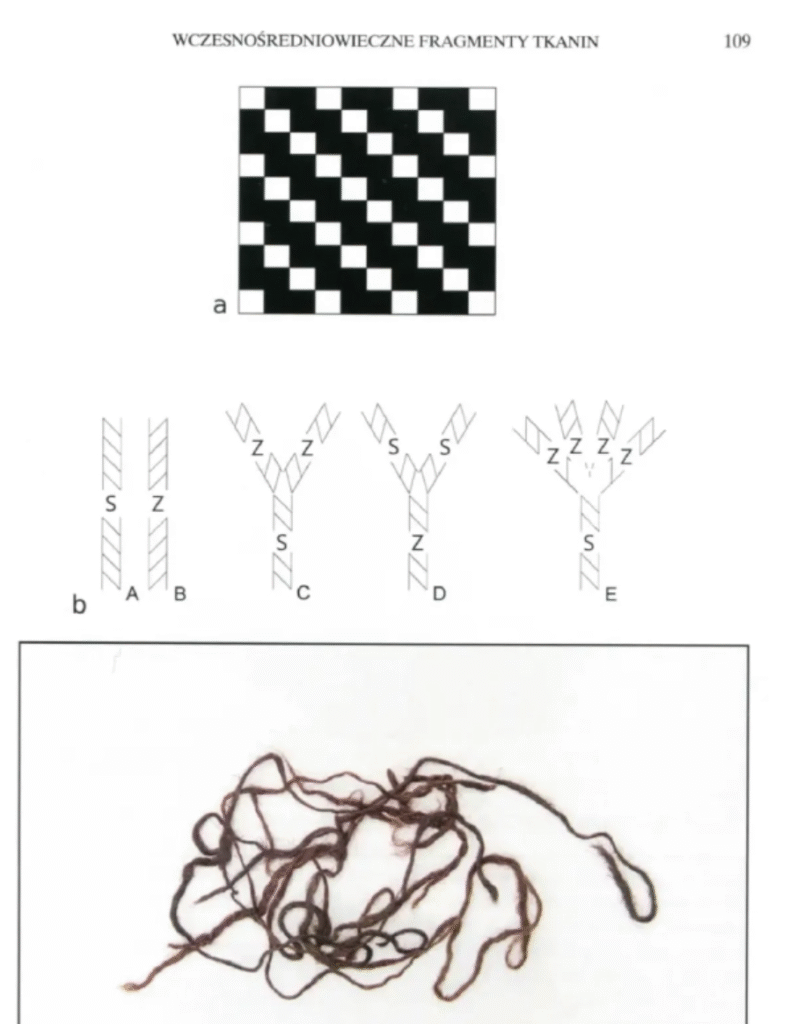
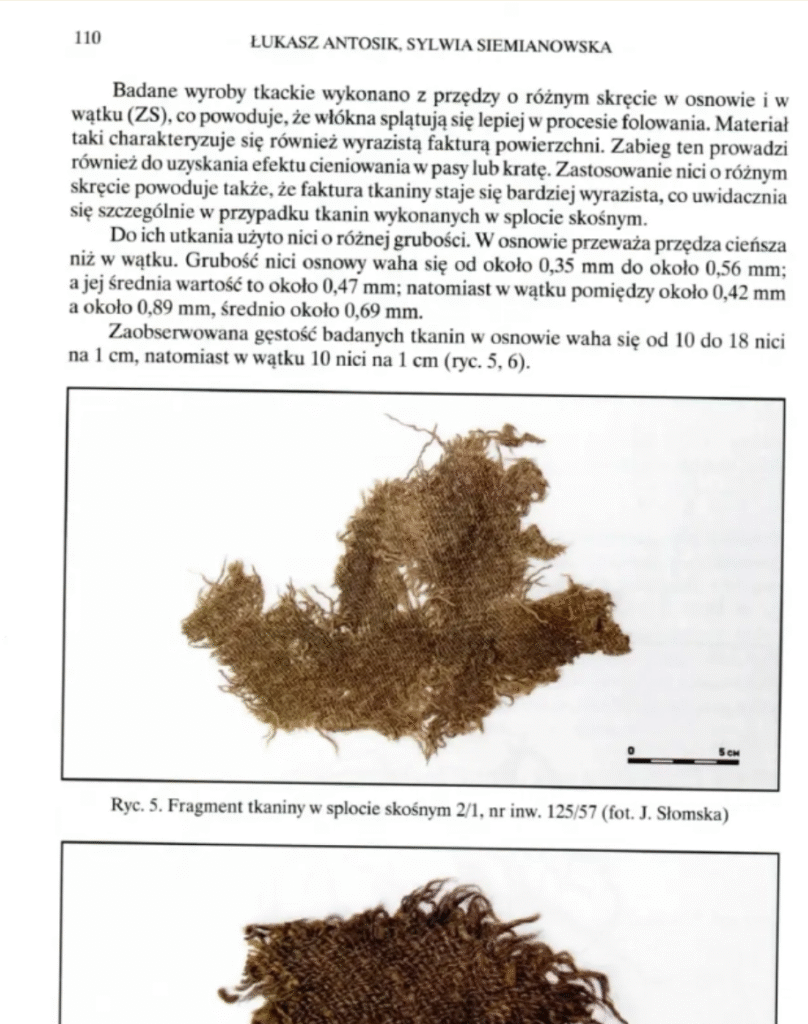
Textile fragments from Domosław near Wrocław are about 2,500 years old and feature a more complex, diagonal weave.
This diagonal weave also appears in early medieval excavations from Ostrów Tumski.
-The first textile factory in Łódź, and the associated industry, is linked to the launch of the first steam engine in Ludwik Geyer’s factory in 1839. Earlier activities were limited to manufactories and the putting-out system.
– explained to me in an email Marcin Gawryszczak from the textile department of the Central Museum of Textiles in Łódź.
So we have traditional weaving techniques from the dawn of time until roughly the mid-19th century, when the first textile, and later clothing, factories began to emerge.
As we know from historical accounts — but also from the number of looms and spinning wheels still sitting in attics and barns in the Podlasie region — people were weaving their own clothes at least until the 1950s. (More on that in a free e-book here)
Professor Maik noted that today, the quality of many old textiles is unattainable, which seems like an unusual conclusion, considering that today’s fabrics are produced in modern factories.
Healing properties of old Slavic clothes?
So, we have high-quality clothing — but not only that. Other interesting insights come from the author of the blog Dzikie Barwy (Wild Colors), who professionally works with dyeing fabrics using traditional, natural methods:
“Linen has antiseptic properties — research from the Institute of Natural Fibres in Poznań found that linen clothing possesses very high hygienic value (…) The same source states that linen positively affects the human body, does not cause allergies, and even strengthens the immune system.”
On the website of the Polish Chamber of Flax and Hemp, we also read that linen has bacteriostatic and bactericidal properties.
Additionally, flax fiber contains lignins, which are excellent natural UV radiation absorbers — making it perfect for summer. It is not attacked by moths, fungi, or bacteria. What’s more, it is resistant to seawater. As if that weren’t enough, linen fabrics have thermoregulatory abilities — in the heat, they cool (absorbing moisture and warmth), and in cold weather, they retain body heat.
A strong protective power could be manifested by any red object, which was the most effective against spells. Slavs commonly used red scarfs, beads, belts or ribbons which protected not only people but domestic animals as well”
What is Living Clothing?
The term ‘living clothing’ sounds quite complex, but in reality, the word ‘living’ says it all. It’s clothing made by a LIVING person, not a machine, and from LIVING, not artificial materials.
If, during the creation of a specific item, a person puts a part of their soul into it — making it in a particular mood and with a specific intention (as women once did when sewing shirts for their husbands going off to war) — then the person wearing that item will receive that energy.
At the museum in Mielnik, one can see traditional folk towels that we further discussed here:
Protective patterns were embroidered on them, and they were used to wrap a newborn child after birth.
That same towel could later be used, for example, to tie the hands of a bride and groom during a wedding ceremony.
In the end, the person was laid to rest wrapped in that towel, which symbolically — and sometimes practically — protected them throughout life. In Podlasie during Orthodox wedding some still stand on a sacred towel like this, and then go back home where a mother greets them with a Korovay wrapped in – You guessed it – a sacred towel.
Everyone also had individual protective embroidery on their shirts, which is why the act of giving someone your shirt in Poland is so highly respected (“he gave him the shirt off his back”, “to give someone the last shirt” etc.).
What fascinated me was that protective symbols were embroidered on the throat, wrists, waist, and hem — because these were the areas through which bad energy could most easily enter. (That’s also why, in Slavic ceremonies and folk costumes, protective belts or krajkas with Slavic symbols are often worn…)
Belt – Krajka
As Kazimierz Moszyński notes:
“Old Slavic belts were most likely made of wool. Leather belts, if used, probably played a much smaller role. (…) Woolen Slavic belts, both in the north (e.g., Poles) and south (e.g., Bulgarians, Montenegrins), were very long—you could wrap them around the body several times. (…) Note one more interesting detail, possibly tied to the ancient use of woolen belts: in many parts of Poland, where both leather and wool belts are worn, only the latter are part of formal or Sunday attire; the former are used for everyday wear, travel, etc. (…) The belt is considered one of the most important parts of clothing in many Slavic regions.”
Embroidered belts (krajki) are still worn during rituals like Dziady. Krajki and belts are key elements of many folk costumes.
Now let’s reflect: men without belts only became a thing like 30 years ago. Meanwhile, women in the ’90s and 2000s got to the point of wearing low-rise pants and crop tops…
Staying on the topic of energy flow—or, more plainly, airflow—consider the difference between tight latex or leather pants versus not wearing underwear under a skirt, as was common for centuries until the 20th century.
Let’s recall our grandmothers’ wisdom: you simply can’t go around with your belly and kidneys exposed without risking a loss of health and energy.
Take one more look at the areas we decorate on a traditional shirt, wrap with a belt, and protect with special care:
“…and here I leave it for consideration that while men often wear belts, women eventually got to the point where they wore low-rise jeans and exposed their belly buttons…)
So, going back to Slavic Traditional Clothes:
we’re talking about clothing of very high quality — antiseptic, antibacterial, UV-resistant, thermoregulatory — made with love and care, thoughtfully designed at every stage, protective and symbolic.
Waste Footprint of Traditional Slavic Clothes
Let’s also note that both hemp and flax have dozens of practical uses (oil, clothing, rope, food, etc.), so in the process of producing such garments, nothing is wasted. The same applies to wool.
Traditional Slavic Clothes used in Folk Magic
Researcher M.A. Kachaeva offers another interesting reflection:
“There are many examples of shirts being used in magical rituals (…) Many ‘cleansing’ rituals to remove illness (…) ended with putting on a new shirt — usually embroidered.” — Kachaeva M.A. “The Rhythmic Composition of Folk Textile Ornament as the Basis for the Energetic-Informational Effect of Ornament on the Human Body”
Each of us has surely experienced this magic firsthand — when, after a few days of lounging around in sweats with a cold, we shower, put on fresh clothes, comb our hair — and suddenly we feel healthy.
Traditional Slavic Clothes vs Modern Clothing Industry
In the past, clothes came from plants that ripened under the sun. They were woven while singing songs, with attention to practices like protective embroidery, following the moon phases, and choosing favorable weaves.
Later, we had exhausted weavers in Łódź (as You can observe in Polish Oscar Movie Ziemia Obiecana), and our friends across the ocean had the horror of enslaved Black people, forced to toil on cotton plantations.
Now, we have overworked children in Chinese factories, chemicals dumped into rivers — not to mention the rashes and chafing caused by synthetic fabrics.
There are many people who believe in the positive and negative energy associated with certain objects. And really, don’t we all prefer to receive something carefully made with love, rather than microwaved generic slop from a supermarket?
From this perspective, considering everything we now know about Slavic clothing, we could say that traditional garments radiated a protective, positive energy — with zero carbon footprint!
Modern clothes, metaphorically, are soaked in blood and sweat, and their production has mainly involved stress, poverty, exhaustion, and fear.
And again, for reflection: what is the state of the modern human being, if this applies not only to clothes but to everything that surrounds us: cosmetics, food, sex, entertainment, information, interior design?
So how to protect one’s energy with clothing NOW?
Does that mean we should be wearing coarse linen tunics? Not necessarily. But we can:
Occasionally buy items made in our own country or nearby, from people who genuinely wish us well. For example, among my Christmas gifts were clothes from Paprodziad’s store.
Repurpose and wear clothes passed down from our grandmothers.
Use old, hand-woven fabrics. My grandma still has a ton of them. You can even find some in thrift stores and on-line.
Sew clothes yourself or go to a tailor.
There are still people in Poland who keep sheep or llamas, and people who make woolen coats. A friend recently told me she has a mini wool spinner, a very fluffy dog, and plans to make… socks out of its fur!
There are still people in Poland who weave fabrics by hand. Usually, it’s rugs, carpets, or tablecloths — but maybe someone could weave a dress too.