Spring begins on March 21st with the end of the “Soroks.” We can slowly start sowing. The earth is awake.The birds are singing. Spring Post
Spring Fastening
The Spring Post is known to both Catholics and Orthodox Christians. It is not a tradition as old as Christianity itself but even older, as during the pre-spring period, there is often a lack of food.
Asceticism fosters spiritual experiences, quietude, and concentration, as numerous hagiographies (such as the Tibetan saint Milarepa, who ate only nettles) convince us. All of this was surely known to many Slavs during the pre-spring period.
In the practical, actionable terms, let’s read about fasting in the life of a village in Podlasie a hundred years ago:
“Women embroidered ritual towels, ‘placing a piece of their own soul’ into them. They often recited specific prayers or spells, which they symbolically ‘wove’ into the towels along with the threads (…). Furthermore, to imbue the towel with holiness and ensure unity with the Creator, it was woven during the fasting period according to the beliefs of the Belarusians when souls purified themselves from earthly influences, experienced enlightenment, and strove for unity with God.”
THE FATE OF MAN EMBROIDERED ON CANVAS – RITUAL TOWEL AS A SYMBOL OF THE MATERIAL CULTURE OF BELARUSIANS FROM PODLASIE Alicja Joanna Siegień-Matyjewicz, University of Warmia and Mazury in Olsztyn
Drowning Marzanna
It is quite surprising to me that practically everyone in Poland drown Marzanna, yet no one has ever asked in school who Marzanna is. Today, even official sources, such as museums, have opened a treasury of information:
The Radom Village Museum writes:
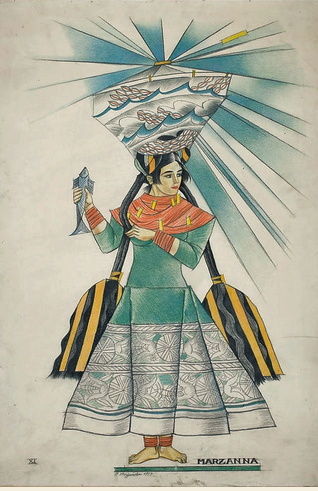
“Marzanna, also known – depending on the region – as Marena, Morena, Morana, Mora, Death, Dust, Deathy, or Winter, is a Slavic goddess of the earth and water responsible mainly for the fertility of arable land – fields, orchards, etc. Her patronage over the land and the sown grain is associated with dominion over the world of the deceased, so she should also be perceived as a goddess of death and the afterlife.”
https://muzeum-radom.pl/wydarzenia/marzanna/1298
On the website of the National Museum in Wrocław, we read:
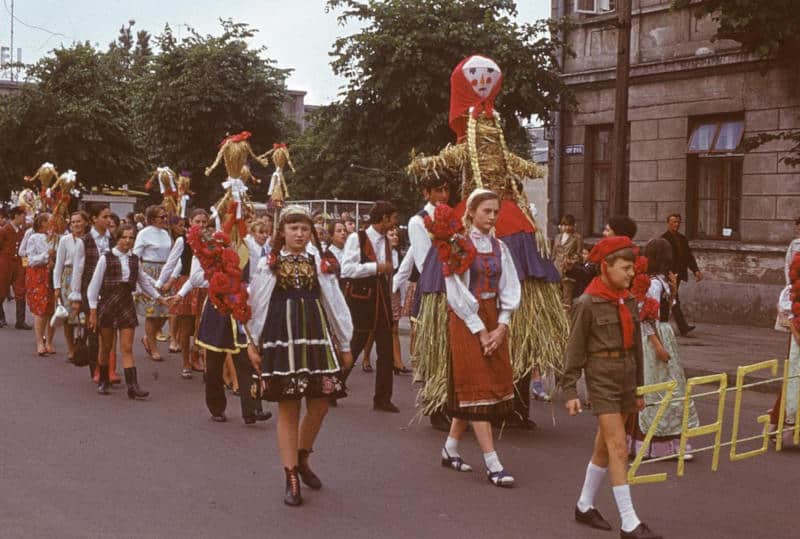
“In the past, in southwestern Poland, in Greater Poland, Silesia, and Podhale, and sporadically in other parts of Poland, this ritual took place on the fourth Sunday of Lent. A doll called Marzanna or Śmierć (Death) was carried in a procession by people from the entire village beyond its borders, where it was burned, drowned, or simply thrown away. Water and fire were symbolic mediums that carried the doll to the afterlife.”
The Regional Museum in Bełchatów adds that besides Poles, this ritual is also observed by Czechs and Slovaks.
Around Easter
Interestingly, in a sermon from as early as 1420, priests said:
“Forbid men from harassing women, and women from harassing men on the second and third day of Easter over eggs and other taxes, commonly referred to as dyngowanie, nor should they drag [each other] into the water.”
Since “harassing over eggs” was prohibited back then, could egg painting have been a tradition older than Christianity? The State Ethnographic Museum in Warsaw writes about this on its website:
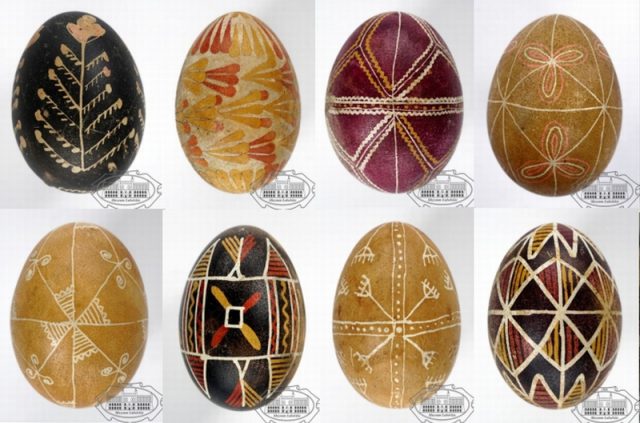
“The oldest Easter egg found in Poland dates back to the 10th century, so it is likely that the Slavs, before accepting Christianity, prepared painted eggs as a symbol of good luck during the spring festival known as the Jare Gody. This symbol was so enduring that it was incorporated into the Christian religion.”
Now we also know that Etruskans and Romans painted their eggs too. Etruskan painted egg from 7th century is practically identical as 100 years old Pisanki from Lublin, Poland:
LRI4689091 Painted ostrich egg, 7th century BC by Etruscan, (7th century BC); Museo Nazionale Archeologico, Tarquinia, Viterbo, Lazio, Italy; (add.info.: Etruscan civilization: painted ostrich egg – 7th century BC – From Pescia, near Rome (Etruscan art: painted ostrich egg, 7th century BC) Dim 16,9×12,1 cm Tarquinia, Museo Civico Archeologico inv 3987); Luisa Ricciarini.
Śmingus-Dyngus
Equally old or older is the symbolism of Śmingus-Dyngus. Beata Kuźniarowska writes in Kurier Historyczny that in the past, it was part of the Jary Goda: Śmingus was “whipping each other” with willow or birch branches (which is still done in Rus, as can be read in the section on Physical Activity/baths), and Dyngus was pouring water on each other, about which I have written previously in the context of shamanism and ancient rain-invoking rituals.
I am not familiar with the symbolism of the so-called “dziady śmigustne” who go from house to house in the vicinity of Limanowa.
Gaik
Just as Śmingus and Dyngus merged, so did Gaik and the drowning of Marzanna separate. The Mazovian Village Museum in Sierpc describes the old custom as follows:
“After burning or drowning Marzanna, the youth would set off in a new procession, this time carrying a gaik, also known as a ‘new little year.’ It was a green spruce or pine branch decorated with ribbons, colored paper, and blown-out eggs (it is worth noting that the egg is one of the oldest symbols of life returning in spring). In this symbolic way, the young people brought spring and new life between the households to replace the banished winter.”
“After the destruction of Marzanna, a triumphal green gaik (maik) adorned with colorful blown-out eggs and ribbons, representing spring and the blossoming of nature, was introduced to the village in her place.”
The Day after Easter – Konopielka Procession
According to TVN24:
“The Easter tradition of caroling, known as ‘chodzenie z konopielką’ or the Konopielka procession, is a tradition of offering agricultural good wishes associated with the beginning of the new farming year. It is known only in northeastern Poland, the Soleczniki and Vilnius regions in Lithuania, and the Grodno region in Belarus.”
Spring All Souls’ Day
Spring Dziady were celebrated in many places in the Slavic lands, and traces of them have survived to this day, sometimes directly and sometimes not immediately visible, although they exist.
Archaeologist Adrian Pogorzelski, in a lecture organized by the Bemowo District Office of the City of Warsaw, explained the meaning of the name of the ceremony called Joście near Warsaw. It turned out to be about food that was once carried in spring as an offering to the ancestors, spirits, and dziady (ancestors). Later, a chapel was built there, and part of the stone was destroyed. However, people still went there. The archaeologist claims that to this day, passers-by leave food there. Processions on Corpus Christi began to be held there to channel this tradition in an acceptable form.
In Krakow, the Rękawka festival is celebrated, when according to scholars previously gaik and money would be put on an ancient kurhan of queen Wendy and king Krak, so the person who finds them remembers about dead (at least according to: Christian churches in relation to pagan cult sites and rituals in Late Antique and Early Medieval Europe, Dariusz Niemiec, Architecture in the Beginnings of Central European States, 2018, Gniezno: Museum of the Origins of the Polish State)
In Belarus, there are still Spring All Souls’ Day observances in some places – Radunica. When I asked my grandfather about it, at first, he said he didn’t remember anything like that. Then he remembered that some uncle did take him for a drink at the graves when he was young, but only after a while did he associate it with the holiday I was talking about. Orthodox Christians also celebrate Prowody, a spring festival for the deceased. In Podlasie my neighbours actually celebrate it!
In this documentary for Polish National TV an Orthodox Priest points out, that when he looks at Prowody he clearly see that our Pagan ancestors took what was the most important to them and brought it along to Christianity with them.
Zielone Świątki (Green Saints?)
If You have any doubt is it Christian or Pagan tradition, let me just pain a picture of the most popular customs for this day around Poland:
Podlasie: weaving wreaths, singing, and electing a queen. Eastern Beskids: jumping over the Sobotka fire. Silesia: boys would put a pole with a bouquet of flowers in front of girls’ houses. Poznań region: dancing around the Maypole. Mazovia: they celebrated the so-called “ox” or “horse wedding.” Animals were dressed up in funny costumes and a puppet with a wooden sword was placed on them, while people chanted “roduć.” The adorned ox or horse would then wander through the villages.
There are often elements similar to the gaik, such as decorating houses with branches, and so on.
There are many other smaller, local traditions associated with this time, and for comparison, in one of the villages in Belarus, they have the tradition of “Wodzenie Krzewu” (Leading the Shrub):