
Once a guest from a distant, exotic country came to Poland. My friends prepared a welcoming performance consisting of songs from his homeland. Of course, they didn’t know the language and relied on YouTube. It was painful to listen to, and I think not just for me but also for the guest, who hears the originals every day. I thought: he would probably have preferred that we sing him traditional Polish songs… except, of course, no one knew any. And if someone did, they were too embarrassed to sing.
So, let’s get to know them.
Drums
“…reminds us of other leather-made products—musical instruments, including drums (Turnau 1983: 29): After a donkey’s death, they turn its skin into a drum [NKP III: 216], including military drums (…): listening to the dog’s skin.”
— Ewa Młynarczyk, Phraseologisms and Proverbial Expressions in Craftsmanship with an Animalistic Component, Pedagogical University, Kraków
Buk
“Buk” or “bąk” appears in Kashubia, Warmia, and some regions of Poland. It is built from wooden staves in the shape of a small barrel without bottoms. (…) The resonant sounds of the “buk” resemble the sounds of an African tam-tam.
A similar instrument, called “bukać,” “bukal,” or “byk,” is played in villages in Czechoslovakia. In Ukraine, instead of a small barrel, they use an upside-down metal watering can covered with leather. In Russia, according to C. Sachs, a similar instrument is called “rebun” or “rewun.”
— Zygmunt Sobolewski, Folk Musical Instruments of the Slavs with Particular Emphasis on the Polish People’s Legacy, Folk Journal
Drums, as an instrument that even a child can make with some persistence, crafted from animal skin or wood—both widely available materials—are a part of many primitive cultures, including those that flourished in what is now Poland.
Beggar’s Songs
Polish hospitality, which fills beggars’ bags with abundant bread, has always sweetened the fate of the poor and contributed to their numbers. No Polish beggar ever left a peasant’s cottage hungry or was pushed away but was always given a piece of bread and, during meals, a spoonful of warm food.
A beggar was often a welcome guest, as he brought news from the wider world, gathered at fairs and markets, often embellishing them with his own wit and imagination, which encouraged the host’s generosity and kindness. Though not always moral himself, when in a village cottage, he often took on the role of a moralist. His influence did not rely on mindlessly reciting prayers or singing religious hymns—he had other songs that sometimes had a strong impact on household life and the consciences of those who heard them, as if aimed directly at their misdeeds.
— Zygmunt Gloger, Old Polish Encyclopedia, Warsaw, 1900
Dumki
(Traditional melancholic Slavic songs.)
Gędźba
Gędźba—music; a word derived from the ancient instrument called the gęśle. “Gędzić” means to play; “gędać” means to play frequently.
There was an old Polish proverb about girls: “She who reads, sings, and plays the fiddle, is rarely virtuous.”
— Rysiński, 1619
— Zygmunt Gloger, Old Polish Encyclopedia, Warsaw, 1900
Gęśle
Primitive violins that remind me of Tytus, Romek, and A’Tomek because they look like they were sketched by Papcio Chmiel. Used in the Middle East, the Balkans, and Slavic countries—still played in Podhale today.
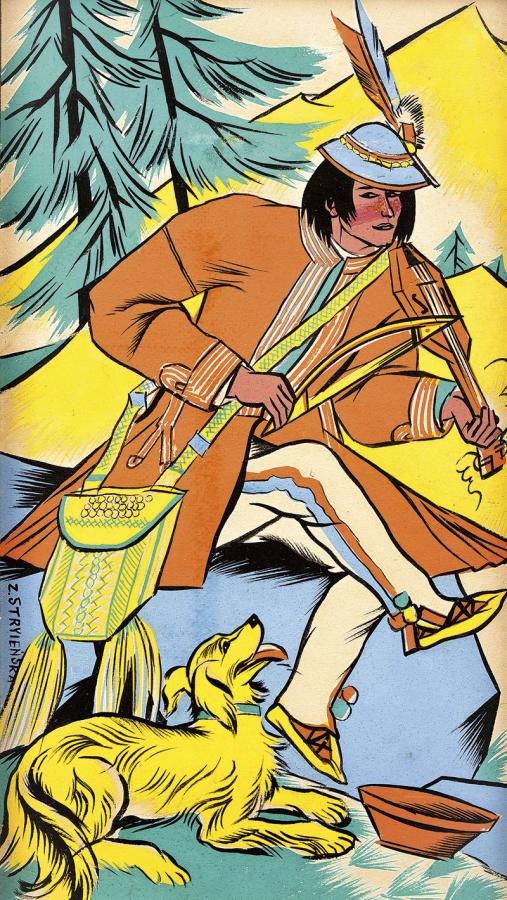
Mazanki from Greater Poland and gęśle (gęśliki) from Podhale are likely the “Polish violins” (polnische Geigen) mentioned by German theorists Martin Agricola (Musica instrumentalis deutsch, Wittenberg, 1545) and Michael Praetorius (Syntagma musicum, 1619).
— Zygmunt Sobolewski, Folk Musical Instruments of the Slavs with Particular Emphasis on the Polish People’s Legacy, Folk Journal
Whistles

“The origins of Slavic folk instruments trace back to primitive types of whistles, pipes, flutes, elder or ivy leaves, reed pipes, bone whistles, pig’s tusks, acorn caps, plants growing in marshy meadows, rye stalks, goose feathers… These were musical devices used by shepherds, children, and rural youth.”
— Zygmunt Sobolewski, Folk Musical Instruments of the Slavs with Particular Emphasis on the Polish People’s Legacy, Folk Journal
Even today, you can buy folk-style clay bird-whistles at fairs and in Cepelia stores.
Let’s also mention the world’s oldest flute, found in Slovenia—it is 43,000 years old! It was discovered in Divje Babe cave, where there were also cave paintings depicting humans and animals.
🔗 Prehistoric and Ancient Musical Instruments
Hurdy-Gurdy
The crank-stringed hurdy-gurdy, which we see in Matejko’s painting Wernyhora, was still present in Polish lands until World War I, though it had already been largely replaced in the 15th century by the more refined lute. From then on, it remained in the hands of wandering beggar-minstrels, who accompanied their singing of dumki with it.
— Zygmunt Sobolewski, Folk Musical Instruments of the Slavs with Particular Emphasis on the Polish People’s Legacy, Folk Journal
The Oldest Polish Song
The famous Bogurodzica was first written down in 1407 but was composed earlier.
The Oldest Polish Folk Song
“Oj chmielu, chmielu” is said to be even older then Bogurodzica and sang at weddings up until 20th century.
The Oldest Polish Christmas Carol
“Zdrów bądź, królu anielski” (Hail, King of the Angels) dates back to 1424. A record of this carol was found in the 19th century in Saint Petersburg by Aleksander Brückner.
Ohulki
Wikipedia:
Spring songs of Belarusians from Podlasie and Polesia, sung especially from Easter to Prowód (a post-Easter holiday). During this time, young people, mainly girls, sang ohulki, which focused on themes of awakening nature and blossoming feelings between boys and girls.
The first mention of ohulki was recorded by Józef Jaroszewicz in an 1846 article on Podlasie’s Kupalnicas (Ondyna Druskienickich Źródeł periodical, Grodno).
Ocarina
The ocarina is known worldwide, but listen to how a Macedonian ocarina sounds—it’s 6,000 years old:
Oj Dana, Dana!
A traditional Slavic refrain in folk songs and dances.
Funeral Songs
Slavic Mantras
Unfortunately, there is no evidence that Slavic mantras existed… but now they do!
However! The swaying Cossacks by the Don, murmuring songs… Belarusian folk songs that induce a trance…
White Singing
Trávnice
Melancholic Slovak women’s songs sung during hay drying—on mountain meadows and on the way back from the fields.