A work was created on this topic entitled “Baba Yaga as a realization of the Wild Woman archetype in Polish fairy tales” by Bogumiła Dziel, whose motto is a quote from “J. Barszczewski: Szlachcic Zawalnia, or Belarus in fantastic stories, St. Petersburg, 1844”:
In the community, the verse about this Baba-Yaga is still repeated…
What else can we learn from this work?
Andreas Johns in his monograph titled “Baba Yaga: The Ambiguous Mother and Witch of the Russian Folktale” states that she is “one of the most characteristic and memorable figures of East European folklore.” Her appearance and attributes remain unchanged in various representations. An old, ugly woman with a hooked nose, long chin, and bony legs lives in the forest in a peculiar house on chicken legs and has only a cat or a crow for company.
The researcher concludes that Baba Yaga is most often considered to be a witch, deity, or demon.
Beregini
Beregini statue in Kyev
The Slavic belief in feminine mythological beings was described by Procopius of Caesarea by means of interpraetatio Graeca (“They also worship rivers, nymphs and other deities” (…). The ethnographic evidence for belief in South Slavic vily and samodivy reaches back to 12th-century sources, and Medieval Russian beregini (“‘guardians”‘) to 11th-century sources.
S T U D I A M Y T H O L O G I C A S L A V I C A, 2 0 1 7, Rusalki: Anthropology of time, death, and sexuality in Slavic folklore, Jiří Dynda
Bobo
In Greater Poland and Silesia, they were also called bobok, babuk or bebok. Oskar Kolberg noted the saying: “be quiet, or the bobok will take you”, and lullabies about bobo were known in the area of Sandomierz and Olkusz.
Chochlik
CHOCHLIKI, or ‘little devils; mischievous spirits’, were introduced to us by Juliusz Słowacki, who extracted them from the singing, folk Belarusian language and included them in his poems. Belarusian CHOCHLIKI means ‘little devils’, and literally ‘tops’. In Belarus, the devil was imagined with a tuft on his head (similar to that of a Cossack) and was called “chachłatyj”, which means ‘tufted’.
I feel cold just thinking about them. Biali, zimni ludzie supposedly roamed the Mazurian forests, and the local website states that they are “unknown specters that haunt the soul and blood, as well as bring mysterious diseases and werewolves, especially popular in forests and wilderness.” There can only be one association.
Czart, czort
Originating from Polish, the word “czart” has been in use for a long time. The younger version of this word is “czort,” which is more commonly used in everyday Polish and has been borrowed from the East.
One can also live alongside the “czart” by making offerings to it. As the proverb teaches us: “Offer a candle to God and a burnt offering to the czart” and “If you live on the edge of the forest, make friends with the czart.” – from the book “Bies n a s z – j a k pan Boruta et consortes—to z miny i z czupryny; b r a t szlachcic”
In the old Polish tradition, they were known as guardian demons (Udziela 1947, p. 261), the so-called ubożęta, which means poor creatures or those originating from God. Maciej Stryjkowski mentions such figures in his Chronicle of Poland, Lithuania, Samogitia and All Rus’ (1582; he calls them krasnymi ludźmi).
Słownik Polska Bajka Ludowa pod red. Violetty Wróblewskiej
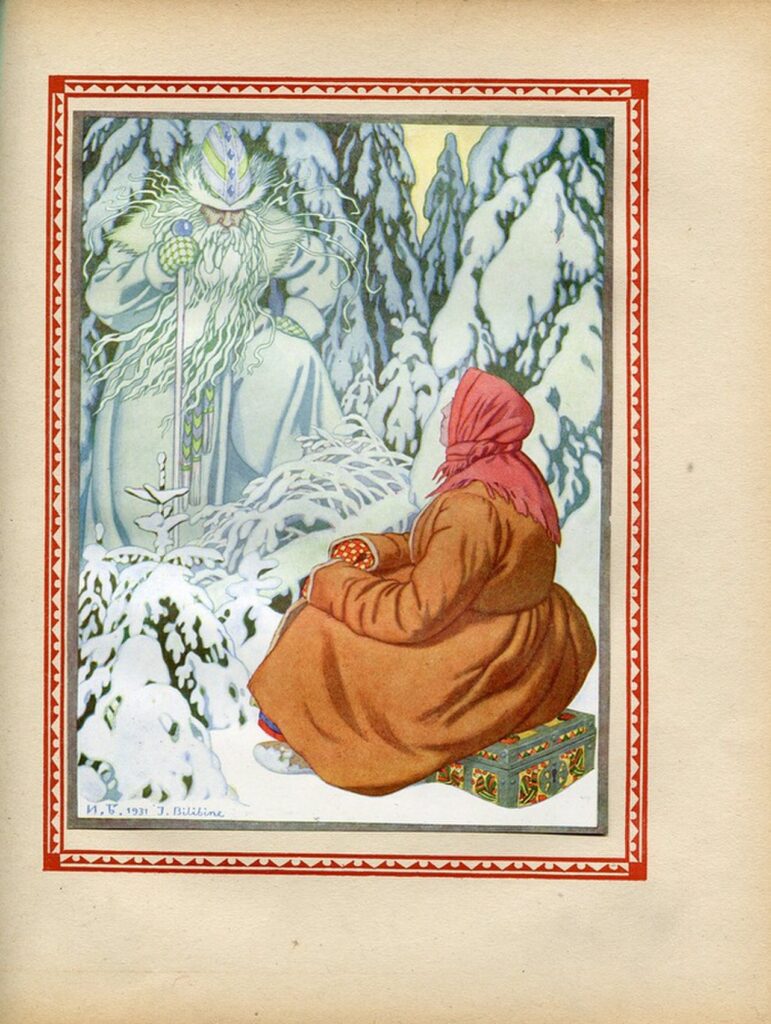
Dziad Mróz
Dziad Mróz (Grandfather Frost) has never visited me in Poland and has always been associated with some eastern attempts to impersonate Santa Claus, but it reminded me that I’ve heard that some children in Poland are visited by a rather niche character called Gwiazdor (Starman), so for the sake of fairness, I also mention Mróz. I don’t have any negative feelings towards other winter Russian creatures (such as Snow Maiden or supposedly existing Zimnik) at all, maybe because they have never imposed themselves on me.
*I know even less about Winter Spas, and I’ve heard that he was “the original” Slavic Santa. It is associated with 6th of December, funnily enough there are Mikołajki on 6th nowadays when we get presents from Santa as well. I have some vague memory of someone in Podlasie mentioning doing something “after Spas”, and Internet mentions archaic folk saying: “Ask Spas, and he will tell Santa”…
Dziwożona
According to Karłowicz, “dziwożona” is often associated with the goddess “Boginka” in Polish folklore. The Tatra highlanders maintain that one “dziwożona” resides in the depths of Lake Żabie and occasionally emerges from it, peeking into nearby villages. She looks monstrous, has huge breasts, and disheveled hair, wearing a red cap on her head. She feeds on the herb “słodyczka” and fears the plant “dzwonek.” She climbs into peasant gardens and causes damage. One farmer caught a “dziwożona” in his orchard and, unable to hold onto her, took off her cap, which she later begged for, singing sweetly under his window. The main dwelling of “dziwożona” was said to be a cave near the village of Łopuszny. Underground, they have palaces full of wonders and treasures.
In Old Polish, “dziwy” and “dziwoki” meant the same as “dziki” (Czech “divoky,” German “wild”); Poles called the wild boar “wieprzem dziwokim,” and the mountain goat “kozą dziwoką.” Therefore, “dziwy” is just a shortened form of the old word “dziwoki,” and “dziwożon” means wild-woman. In Czech, it is “diva žena,” in Łużyce “wódna żona,” and in Hutsul “dykaja żena.” Goszczyński wrote about “dziwożony” in his “Journal of Travel to the Tatra Mountains” and “Sobótka,” the “Advocate of Science” from 1843, and Kolberg in volume VII of “Lud” Poznańskiego, pp. 190-191. This information comes from the “Encyklopedja Staropolska” by Zygmunt Gloger in 1900.
Giants
mong the people there are novels about giants whose height reached nine cubits and who were a nation of God the Father. They tell of a certain boy from this nation who lived until our times and resided near the Vistula river.
Podania i legendy, T. Maciąg, 1902
Gwiazdor (a Starman)
No, just kidding.
As Czesław Witkowski writes in “Polish Folk Customs and Traditions,” the tradition of carolers visiting homes was born then, among whom was a person dressed in a sheepskin coat and a fur hat with a face smeared with soot, holding a star on a pole.
“Gwiazdor carried a bag of gifts and a switch, and depending on the response obtained from the household members (usually children) when asking about their behavior during the year, he either gave a gift or hit them with the switch,” we read in Witkowski’s book.
In cities, Gwiazdor resembles Santa Claus, while in Kashubia, he is still presented as a bum in an old beige coat tied with a rope. Interestingly, this is not the only gift-giving figure in a different colored attire. The Irish have a green counterpart of Santa Claus derived from ancient folklore, and Dziad Mróz (Grandfather Frost) is depicted in blue.
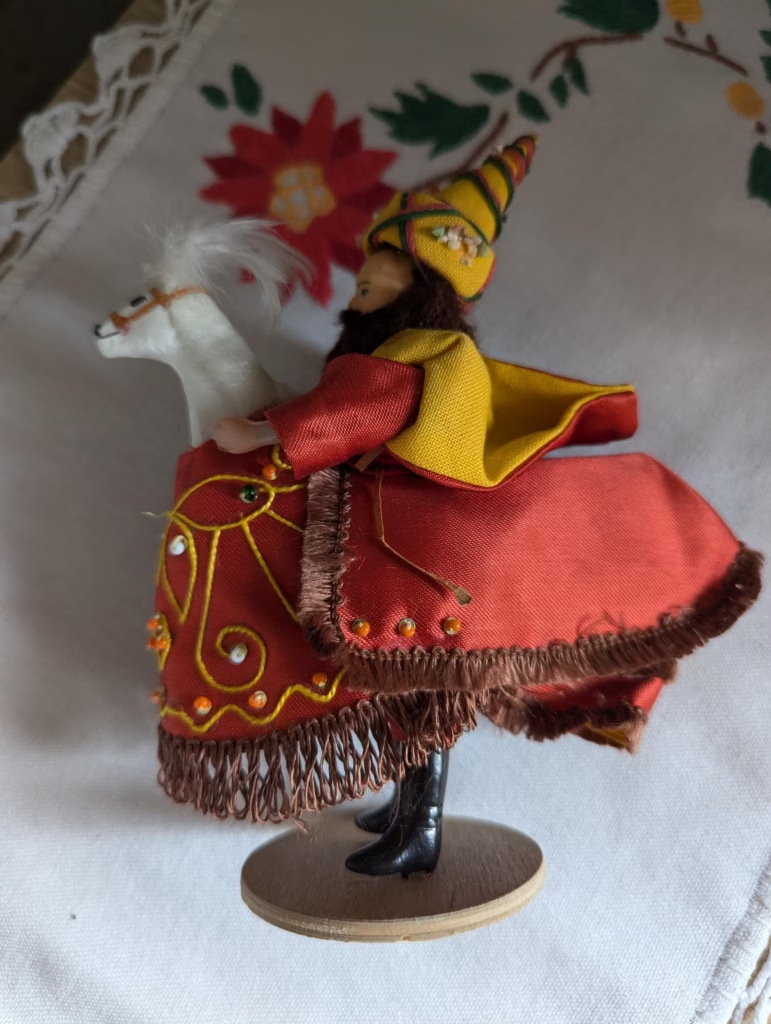
Lajkonik
Everyone vaguely associates the Lajkonik with the Tatars, and perhaps it was really so. However, let us focus for a moment on another hypothesis regarding the crazy, colorful man-horse in a tall hat in the style of “Dziady Śmigusowe” or “Dziady Żywieckie”.
Perhaps it is a relic of pagan holidays in honor of Svantevit or Triglav, traveling the world on horseback? Fascinated by the Lajkonik tradition, Stanisław Wyspiański in “Achilleis” took this character back to prehistoric times, connecting him with the Indo-European cult of water. (…) Additionally, our Lajkonik has numerous relatives scattered around the world. Such games are commonly found among agricultural peoples in the springtime. This action is supposed to have a magical influence on plant vegetation. Games of strange riders on artificial horses (“koniarz”, “kobyłka”) can still be seen today in various parts of Poland.
To be fair I must add, that for some reason in Europe and beyond there are many exactly same traditions, like The ‘Obby ‘Oss festival in Cornwal, Banbury Hobby Horse Festival, Katchci Godhi in India and many more.
Latawiec
a kind of an air spirit in Poland.
Starożytności polskie ku wygodzie czytelnika porządkiem abecadłowym zebrane. Tom 2, Jędrzej Moraczewski, 1852
In the book “Polish Demonology” by Leonard J. Pełka, kites (latawce) are some shamans associated with rain or entities appearing around rain.
Marzanna
We would drown Marzanna in a river even when I was a kid.
Marzanna suddenly rose from being a puppet to a goddess. Such information is repeated on the websites of various Polish museums (e.g. ethnographic ones). Supposedly Mara – the Ukrainian goddess of winter, Russian Marana and Marzanna, who is burned at the end of winter, are the same person…?
Stryjkowski wrote in his chronicle in the 16th century: “The Sarmatians call Ceres, the earth goddess and inventor of all grain, Marzanna; a church was built for her in Gniezno at great expense, where they offered tithes of all grain after harvest, asking for fertile crops for the following year.” In another place, the same Stryjkowski writes: “Grom, Ladon, Marzanna, Pogwizd, Ziewanna yielded to Christ.” Bielski says: “In Greater Poland and Silesia, on the seventh day of March, they drown Marzanna, dressed as a woman.”
Zygmunt Gloger, Encyklopedja Staropolska, Warszawa, 1900
Czech reporter Wacerad emtiones Marzanna in y. 1202.
In 1420 clergymen in Poznań wrote:
“Do not allow the superstitious custom of carrying some figure, which they call death, and drowning it in a puddle to take place on Sunday.”
Kłobuk
“Also known as kołbuk, kobold, chobołd, or latańc, it belongs to the demonic entities that provide material goods to people in exchange for feeding them → with eggs and keeping them in the pouch (Szyfer 1976, pp. 427-428). If not treated properly, it can destroy its → master’s farm, usually by setting fire to the buildings, or move to neighbors, contributing to their financial improvement. In folk beliefs, the kołbuk takes the form of a black, wet chicken that flies out of the chimney of the house it has robbed, carrying treasure, and flies back to its lair, leaving behind a trail of golden sparks. (…)
Interest in this figure dates back to the eighteenth century, as evidenced by the writings of the Germanized Masurian Jerzy Krzysztof Pisański, who in his work “On Some Remnants of Paganism and Popery” wrote about folk kołbuks as evil spirits in the form of → fiery dragons that bring treasure to their guardians (Bajki Warmii i Mazur 1956, p. 73).
Słownik Polska Bajka Ludowa pod red. Violetty Wróblewskiej
Płanetnik
A popular figure in folk beliefs, having power over the weather (clouds), especially rainfall and hail. He is the protagonist of over one hundred legends recorded in sources from the 19th and early 20th centuries.
Płanetnik is one of the most mysterious creatures in traditional Polish folklore, in which their existence was believed. Ethnographic sources indicate that three types of characters with similar functions but completely different origins and lifestyles were actually hidden under the same name. The first category included demons characterized by inhuman origin, often gigantic in size and covered with dense hair all over the body, spending their lives among the clouds, which they could direct at will.
The second type is semi-demonic creatures, i.e. people leading an ordinary daily life, who reveal their extraordinary abilities and nature at certain moments, similar to those that characterized the first group of beings. Despite many similarities, people clearly distinguished them, calling them earthly or lower płanetniks. In legends, they are most often depicted as mature → men, less frequently as young people and elderly persons. Except for Kuyavia and parts of Greater Poland, where a number of reports about so-called water hags were noted, female counterparts of these beings are almost never encountered. Characteristic elements of clothing, including a giant, black hat, a coat from which water drips from the belt (troka), and some detail in red, bring the described demons closer to drowners. At the same time, the props used leave no doubt as to the nature of the encountered character – they include ropes and long, iron levers, with which the płanetniks pull or push clouds, large books carried under their arm, from which they draw their demonic knowledge, sometimes umbrellas, turning which upside down brings rain.
Polish Folk Tale Dictionary edited by Violetta Wróblewska
Południca
Południca is a female ghost who died around her wedding day. She haunts at noon. In my opinion, the meaning is that at noon, while sleeping in the field, one can get a stroke and die, so one should not go alone to the field at the peak of the day. Metaphorically, Południca died at the peak of her life, just like noon is the peak of the day.”
Poorness
In Polish folk tales, “bieda” (poverty) appears as a term for the economic status of the heroes, but also as a personified entity. (…) “bieda” appears as an actively acting antagonist to the main hero. The personified poverty is most often presented as a thin woman with a pale complexion and long limbs, and “her body is covered with a grayish mist, like a fog” (Siarkowski 1885, p. 53).
The appearance of the character may be a result of the deprivation experienced by poor people, but sometimes its appearance is less clear, as in some variants it appears in the form of a small child (Gonet 1914-1918, p. 257) or an owl (Gonet 1900, p. 265). This demon-like entity accompanies the host and his family, bringing misfortunes that lead to impoverishment of those under its “care,” or – if they have already been brought to extreme poverty – hindering their ability to acquire any goods. Despite the distressing consequences of its activities, poverty in folk tales does not evoke fear, but rather laughter and pity. The poor peasant deceives it, taking advantage of its greed or childish desire to be better than him, and by deceit, frees himself from its influence. Thus, tales of the impoverished are part of a series of texts about the tricked monster.
(Polish Folk Tale Dictionary, edited by Violetta Wróblewska)
Field spirits
In Poland, one of the field spirits is called “południca”, which is believed to abduct those who fell asleep in the fields at noon (and suffered a stroke). The pagan gods of the field included “biełun” and “palewy haspadar życień”, also known as “bahacz”. In Western Belarus, it was called “spieszka-sparyszka”, “sporysz”, “sparna”, and in Folesie and Witebszczyzna it was called “raj”. In Russian beliefs, the equivalent of these gods was the “rżanoj diedw”, also known as “owinnik” in winter. Among the Lithuanians, the field god was called “łaukasargas” or “łaukpatimus”. Biełun was considered a protector and helper of harvesters in Belarus. His permanent residence was believed to be in the forest, from where he guided lost people back to the right path. He appeared among the crops as an old man in white with a pouch and a golden bag attached to his nose.
Maciejek, AlicjaDemony przyrody i personifikacje zjawiskprzyrodniczych w wierzeniach ludu białoruskiego wXVIII i XIX wiek, „Rocznik Białostocki”, 13, 1976, s. [151]-164
Rusałka
there are considerable differences between the image of rusalka of the Southern/ South-Western type (from Ukraine, Belarus and South-West Russia) and the feminine water-being of the Northern type (from Russian North, Volga, Ural, and Western Sibe- ria regions).
The invariant features of the “canonical” Southern type are: the feminine representation of rusalki, their seasonal appearance on the Trinity and Kupalo period, strong affiliation with the category of unclean dead, occurrence in rye fields, woods and nearby rivers or brooks, and also the tickling of men. They always appear in group, as a plurality. Southern Rusalki are usually described as young and beautiful girls. They can appear naked, or clothed in white (or wedding) robes. One of their most distinctive features is hair of green, golden, or strawberry blond colour. In sources from the northern part of the East Slavic area, the word rusalka as such is not attested, but instead the lexemes vodjanucha, vodjanica, kupalka, chitka, or šutovka are used for a mythical being with somewhat similar characteristics (Zelenin 1995, 146; Vinogradova 2009, 495) and thus not clearly identified with rusalka. Vodjanucha is solitary being, usu- ally represented as an elderly and ugly woman with dark, wet hair, cold hands and saggy breasts.
S T U D I A M Y T H O L O G I C A S L A V I C A, 2 0 1 7, Rusalki: Anthropology of time, death, and sexuality in Slavic folklore, Jiří Dynda
Sierbay
Mythical creature embodying hunger.
Słownictwo polszczyzny gwarowej na Brasławszczyźnie, J. Rieger, 2014
Śnieguroczka
A character from Russian folklore, she lives in a winter forest, possibly the daughter of the Snow Queen and Father Frost.
Upiór
Ghost, corpse. In the 18th century, Father Jan Bohomolec wrote about the superstitious belief in ghosts: “Ghosts, according to belief, are corpses rising from coffins, haunting homes, suffocating people, sucking blood, crawling onto altars, bleeding on them, breaking candles”. Some call a female ghost a “strzyga” (from Latin “striga”). L. Gołębiowski says that “the ghost, according to popular belief, has a dual life, having lost the first, it uses the second at night, causing trouble and harm, either in household matters or in sacred matters.” The ghost comes out of the grave in the moonlight and can only move along its rays; it attacks sleeping girls or young men whose sweet blood it sucks without waking them up.” T. Czacki writes: “I still remember how ghosts were searched for (in graves in Volhynia), heads were cut off with hoes, and hearts were pierced with an ash stake” (to stop them from being ghosts). The severed head had to be placed between the legs. Rzeczniowski, in the history of m. Łomża, cites a description from the 16th century of how the people fulfilled this disgusting superstition.
Zygmunt Gloger, Encyklopedja Staropolska, 1900
Żarptak
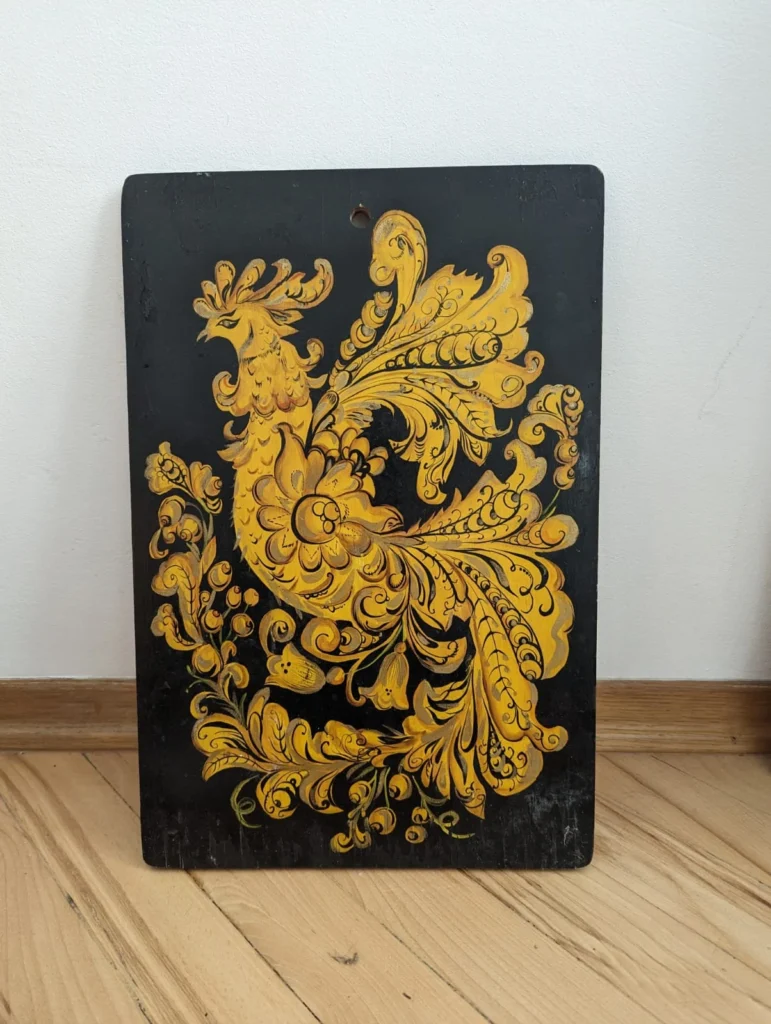
Essentially it is a Russian fenix of sorts. This one belonged to my grandma: