Searching for information about ancient Slavic (or more broadly, pagan) cult sites,You can quickly come to the conclusion that nothing is known, and everything remains uncertain. Especially, if You rely on internet:)
Wikipedia provides us the most basic information – Wolin, Ślęża, Łysa Góra…
One could conclude that indeed three places of worship existed in Poland, so there is nothing to discuss. Or is it???
Delving into this topic, I noticed that there are thousands of such pagan shrines, ex-temples and sacred places (a list is here)
They can be found in your municipality or city, regardless of where you live.
Moreover, you don’t need to conduct any tedious research – these places are within reach, and you probably have heard about them at some point.
They are so obvious that they don’t even come to mind…
So how do you find an ancient pagan sacred site in your area of Poland, Lithuania, Czechia, Belarus? It’s actually very simple:
Look at the names
Sometimes we have something right in front of our eyes and still can’t see it. This applies precisely to the places of Slavic cult. Pay attention to the names of towns, districts, and areas. Check out place names like “uroczysko”, meaning sort of enchanted place in a forest or outside of the village where miracles or other things happened in the past. They are everywhere.
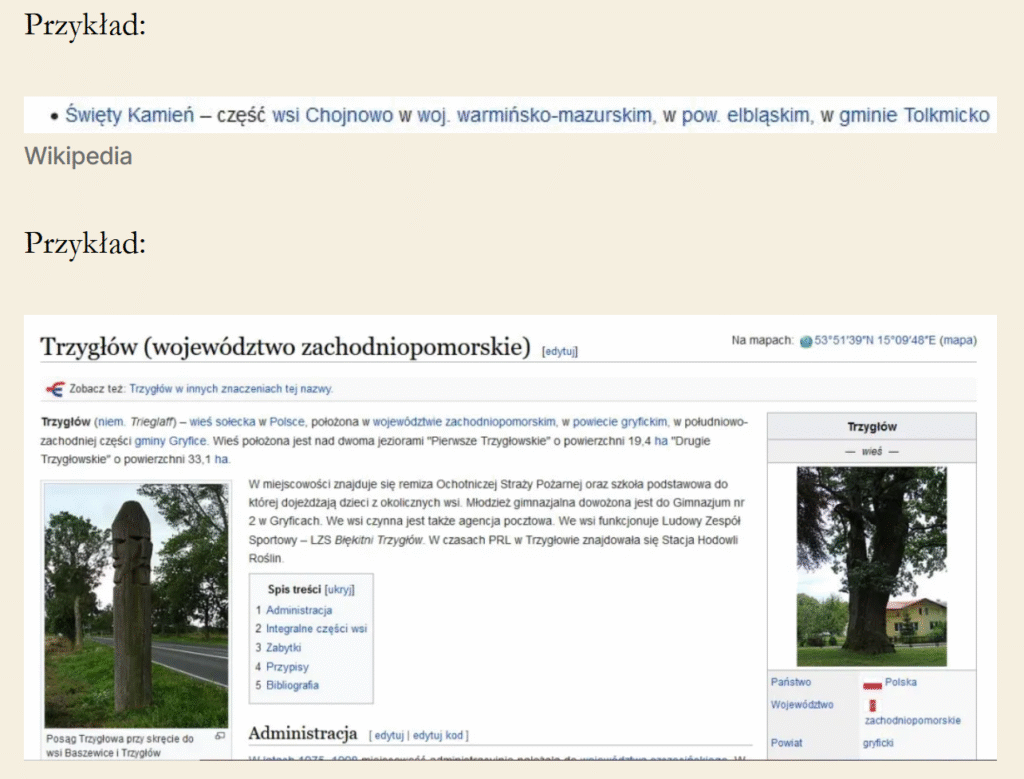
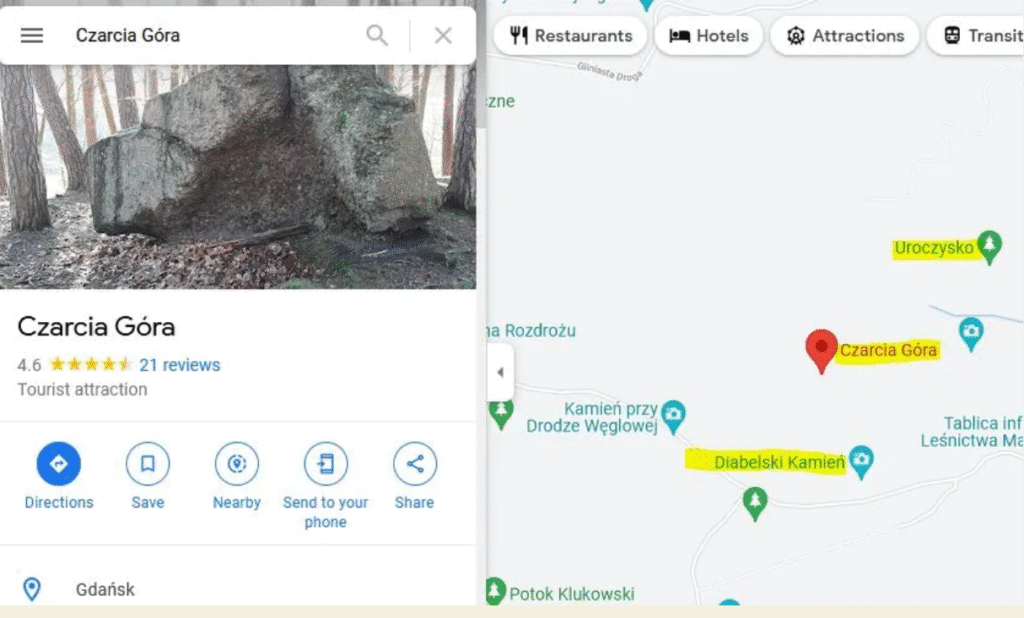
An exampleof “Sacred Stone” , part of a village in Hojnowo, Triglav village, a Devil’s mountain” with “uroczysko” and “devil’s stone” nearby… , Wikipedia
Another example:
Święta Lipka, Sacred Linden Tree – There is a Christian Sanktuarium in a village named Święta Lipka, sacred tillia tree, and it is widely known that before it was a sacred place for Pruss People, who would pray to the trees…
Don’t ignore common names, names that Your grandpa would use when talking about a certain place.
An example:
Near a certain village there is a place called “Pagan Graves” , and archeologists have found burial mounds nearby indeed, Wikipedia.
Pay attention to the names of nature monuments, erratic boulders, rivers and stones.
Example:
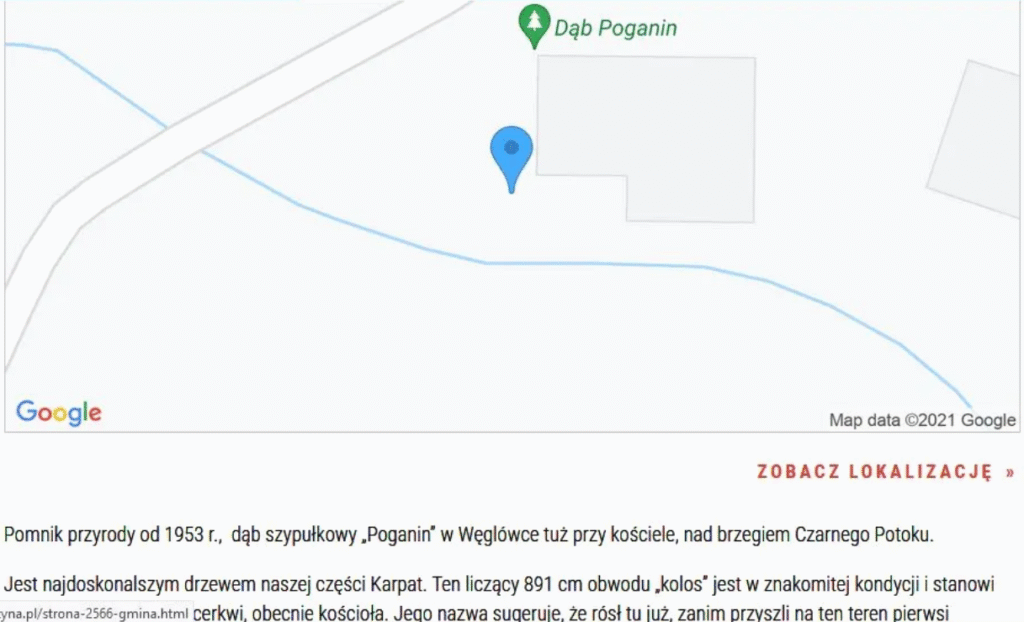
Hundred years old, huge oak in southern Poland is named “Pagan Oak”… Was it a place of warship?
An example:
There are numerous accounts of pagan, then folk, then Christian festivities happening on the Triglav stone. People had put food and flowers as sacrifice there till recent days. What is interesting, it is at the cemetery, probably because there was a sacred site already hundreds of years ago.
Check the shrines and sacred places.
Very often, shrines were erected on previously sacred stones next to holy springs.
An example:
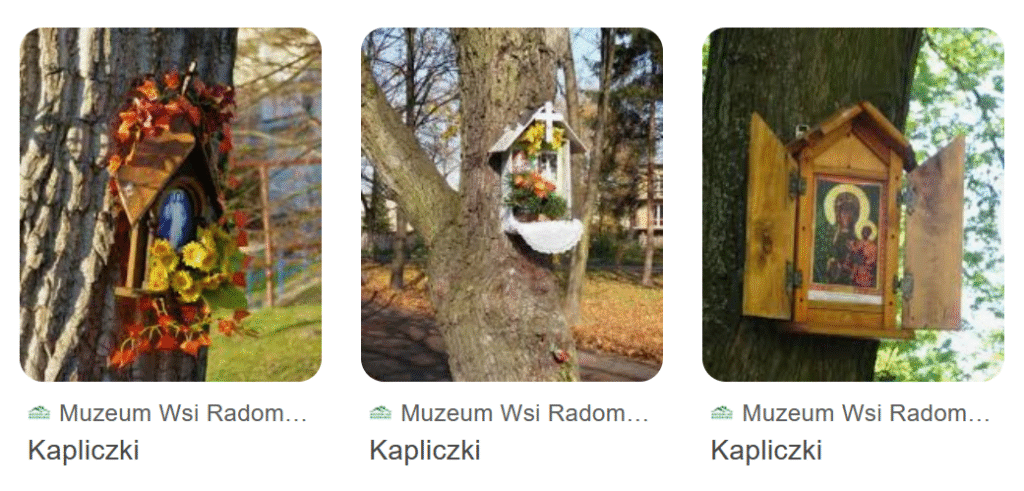
Notice that in Poland, chapels with characteristic roofs are often seen on the trees – these are very often the so-called “holy trees,” sometimes remnants of the so-called holy groves.
An example:
In Radom, the Museum of Radom Countryside stands out with its 25 shrines on trees, highlighting that: “In pre-Christian culture and symbolism in Polish lands, trees represented a variation of the axis connecting the human world with the divine world. In Slavic mythology, there was a concept of the “Tree of Life” or “Tree of the World” (…) Ancient, giant oaks, linden trees, sycamores, pines, and willows served as local “Trees of the World”. The trees designated for placing shrines on them became sacred in themselves.” [Source: Museum of Radom Countryside]
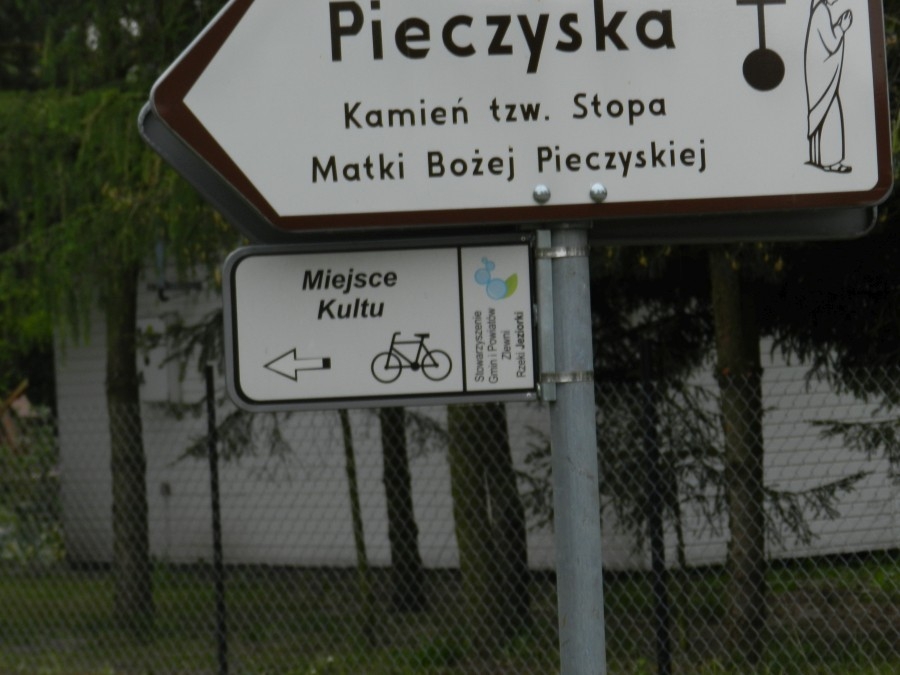
Check to see if there are any Devil’s stones, God’s feet, or Holy stones in the area.
Very often these are ancient stones used for rituals.
Very often, majestic mountain peaks served a cult function…
Example:
On the Witosławska Mountain, according to the State Forests website: “In this region, the religious cult on this mountain dates back to pagan times. A Christian temple was built on the site of the pagan temple, with a pilgrimage on the day of the Descent of the Holy Spirit.” [Source: [https://www.radom.lasy.gov.pl/aktualnosci/-/asset_publisher/1M8a/content/gora-witoslawska-jako-miejsce-kultu-religijnego/
https://www.youtube.com/watch?v=lBKKK9LRWt8
…and small hills are often burial mouds. Since I started to pay attention to them, I have found a dozen within a 15 km radius from my home, including the burial site of the Jaćwing tribe leader.
Example:
Check local stories, legends, beliefs.
That is the only point that requires greater effort, but sometimes it’s worth taking it. You can start from a local legend that contains any mention of pagans, witches, cult places, haunted forests, etc. and search for further information in the local press, books, museums.
Example from the vicinity of Hajnówka:
In the ethnographic borders of Belarus near the village of Czyży (former Białystok province), there was a hill called “Srebrnaja Górka” (Silver Hill). The hill received its name due to the fact that golden and silver idols (gods) used to stand on it in the past. The name of one of them, Lelyak, was mentioned by the peasants. Source: Archaeological map of Grodno region from 1895, https://pruzhany.net/2703-yazycheskie-idoly-na-territorii-belarusi.html
The presence of extraordinary places in the municipality, including “Srebrna Górka” (“Silver Hill”), is confirmed by the “Archaeological Guide to the Czyże Municipality” (“Przewodnik Archeologiczny po gminie Czyże”).
Sometimes there are certain places where you just “don’t go”, even though it’s not really known why.
Go where the walking takes you, anyway.
Think about where in your area festivals are organized to celebrate Midsummer Night, where people go for picnics and bonfires, and where processions for Corpus Christi or Easter take place.
You probably already found this place looking according to previous points and there is a sacred spring, interesting stone or some telling name on the map.
Archeological sites
Often some area is called Grodzisk or Grodzisko, because there was a …grodzisko ( an old city, a stronghold) there. The same goes with Wiec, Kościół, Mogiłki etc.
Often, so-called cult objects, cemeteries, stone circles, earthworks, sacrificial stones, places of "probable cult purpose" etc. are found at such places.


Sometimes archaeologists are sparing in their conclusions or wait for the results of research, which can drag on for years. In such a case, it is worth supplementing their knowledge with conclusions from other points (interesting names of places and legends about the area), as well as visiting the site in order to form your own opinion about the terrain, atmosphere, etc.

Very often, there is several pieces of information in one place suggesting that it is a unique place.

Example:

In the village of Nowy Wiec (the name suggests a place where larger, important meetings take place), a two-headed statue from the 10th-11th century was taken out of a swamp. 700 m further on, two settlements from the 8th-9th century were discovered. Next to it is Lake Starowieckie (where rallies used to take place?). More: https://twojahistoria.pl/2019/10/08/belbuk-swarozyc-a-moze-odyn-kogo-przedstawialy-tajemnicze-rzezby-z-terenu-ziem-polskich/

Example:

A stone head was found in the cemetery in Dobczyce, which is in the storage room of the local museum, described as the head of Swarożyc. A few hundred meters away, there is a linden tree with a Marian statue and an open-air museum, and in it a chapel, about which the city guide writes: "According to legend, this figure was originally a statue of Światowid. It once stood at the crossroads, next to the manor house in Gaik, now this area is underwater." So we have Gaik, a statue of Światowid, a mysterious head and a holy linden tree in one place... There is also a barrow in Kornatka in the area. more: https://www.dobczyce.pl/dla-turystow/zabytki2.html ; https://isap.info.pl/2020/03/13/glowa-swarozyca-dobczyce/
Very often we search for beliefs and places important to our ancestors thousands of kilometers from our home and in really ancient times. Meanwhile, this knowledge is at our fingertips.
If some customs in your region have still been preserved, you know them from home or from festivals, you have free access to these places, then You are really lucky.
What then? Such a place can be great for meditation, personal practice, celebrating holidays, or maybe for celebrating birthdays and important events for your family?
It can be a good place to reflect on yourself or your region. Some people look for treasures, or quite the opposite - they clean up devastated and forgotten places like that. Another idea is workshops, shows, lectures in picturesque scenery...
You yourself will know best what to do with this place, and older accounts or written sources can still help you understand the potential of a given area. Of course, I encourage caution, because the place you find can be both wonderful, but also pretty negative…





[…] More: How to find a pagan sacred place from the past in Eastern Europe? Easy! […]