
From time to time I come across some black-and-white photo of a Slavic figurine or ornament, or a brief description with a note stating that the “artifact has been lost.” Initially, I added these scattered pieces of information to sections on beliefs, statues, or art. Eventually, I created a separate section. Below, we can look at at least a few such lost artifacts.
I find these in random articles, but an interesting source may also be the War Losses Catalog of the Department of Cultural Property Restitution, though I warn that it is difficult to navigate.
Choniakow Treasure


Golden Baba
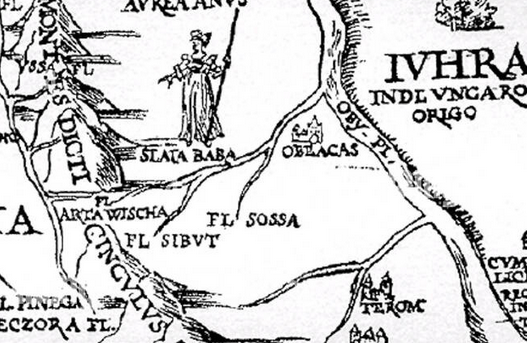
“Beyond the land called Vyatka, on the road to Scythia, stands a great pagan idol, the Golden Woman […]. The local peoples worship this idol, and no one passing nearby or hunting animals will leave without making an offering.” — Traktat o dwóch Sarmacjach, Maciej z Miechowa, 1517
“The Golden Woman […] is an idol that stands at the mouth of the Ob River in the province of Obodra on the shore. — Rerum Moscoviticarum, Zygmunt Herberstein, 1549
Grunwald swords
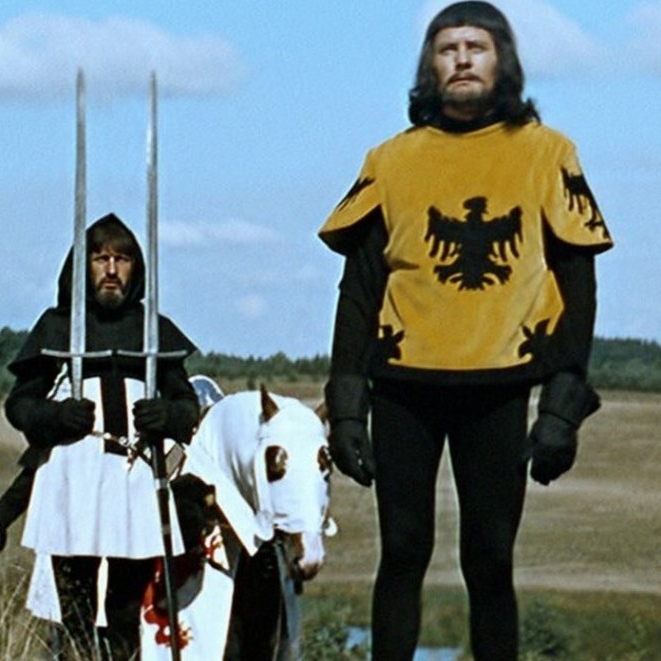
The Grunwald swords, which survived the Prussian plunder, were taken from Kraków by Tadeusz Czacki and gifted to Duchess Czartoryska for her collection. After the fall of the November Uprising and the evacuation of the museum to France, they were placed in the care of a priest in Włostowice. They remained there until 1853, when a Russian gendarme discovered them and confiscated them as… illegal weapons. He took them to Zamość, where their trace was lost.”
— Focus, Crown Jewels of Polish Kings – Where Are They?, 2012
Idol from Łysa Góra
“In front of the doors of our church, while carving into the rock, they happened upon a place where an old idol covered in charcoal was found.”
— O. Jabłoński, 1686, https://www.swietykrzyz.pl/kategorie/czasy-przedhistoryczne
Lithuanian Deity Pikele
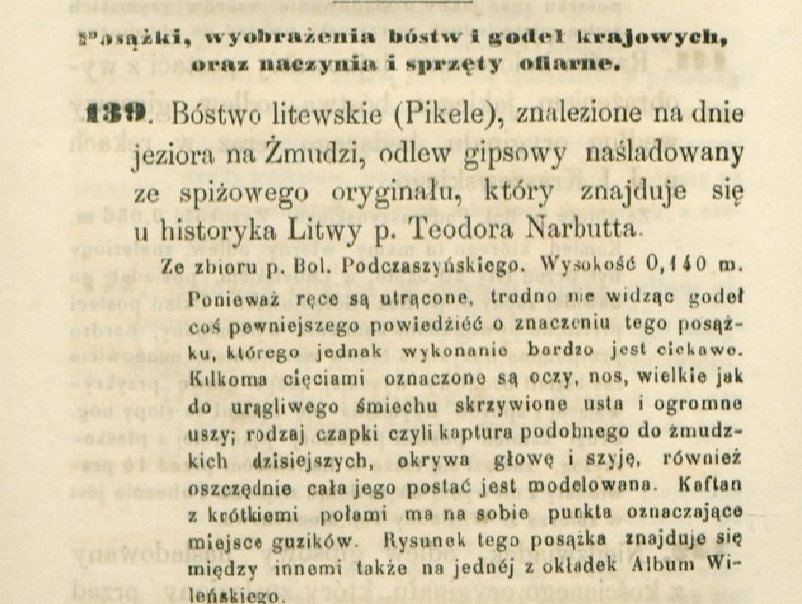
Egg-shaped Sculpture
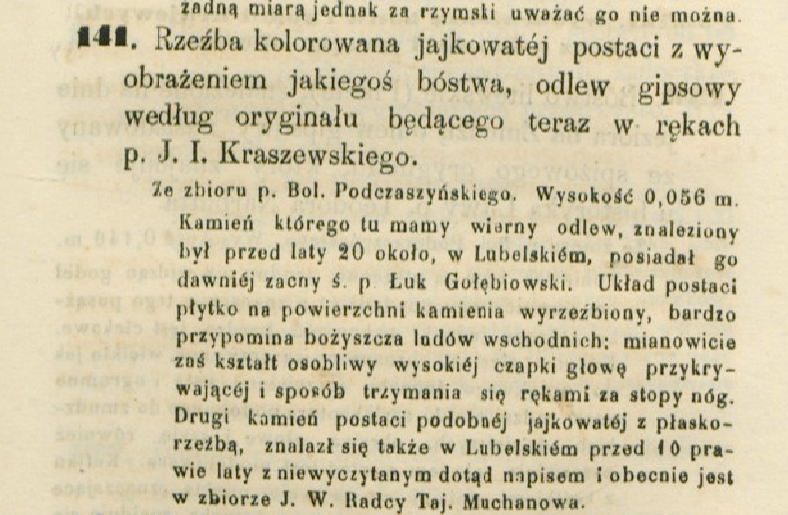
From the same 1856 Catalogue of the Exhibition of Antiquities and Works of Art.
Statue of Trygław
One of the last fragments included in the lives of the missionary [Otto – editor’s note] describes the concealment—after the official Christianization of Pomerania—of a golden statue representing the god Trygław. Originally kept in Szczecin, this idol was hidden inside a hollow of a certain tree, in a village unspecified by the chronicler.
— Religion of the Pomeranians in the Early Middle Ages, Kamil Kajkowski, Andrzej Kruczkowski, 2010
Another Trzygław Statue
“There was a three-headed statue in Szczecin, with three heads on a single torso, called Trzygław. (…) Otto took the three heads, after breaking off the torso, as a sign of victory and later sent them to Rome to present to the Pope as proof of their conversion.”
— Religion of the Pomeranians in the Early Middle Ages, Kamil Kajkowski, Andrzej Kruczkowski, 2010
Spearhead from Kovel
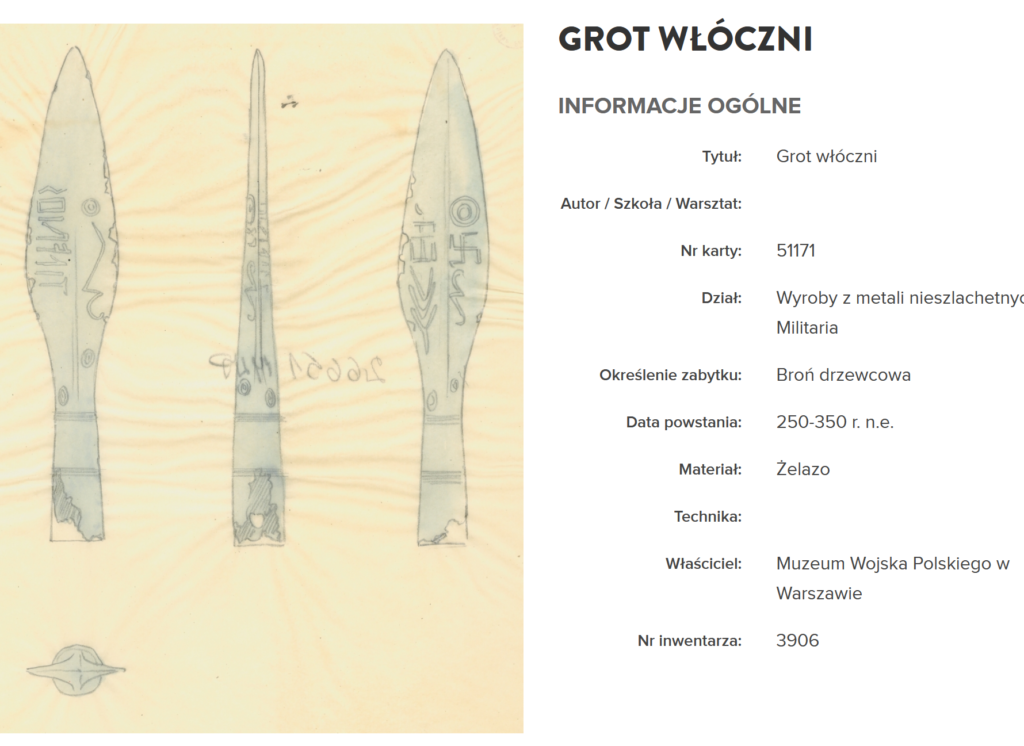
Unfortunately, everything bearing a swastika has been snatched by “mystics” from beyond our western border… I wonder where it is now and why?
Silver head of a bull
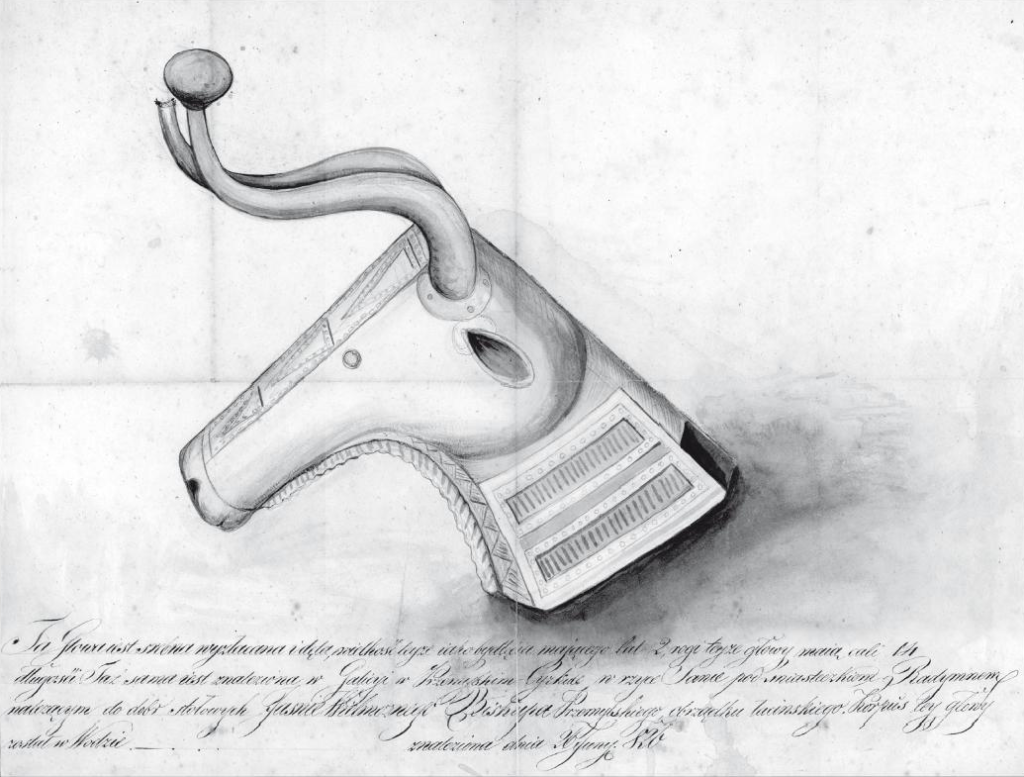
“In Galicia, near Radymno, a town belonging to the Bishop of Przemyśl, fishermen searching for wood in the San River with hooks stumbled upon something that resisted their efforts and produced a metallic ringing sound. Digging deeper with their hooks, they soon pulled out an enormous, corroded head, whose wild shape so frightened one of the fishermen that he nearly dropped it back into the water.
This head, made of drawn silver of the thirteenth standard and once gilded, weighs about three Viennese pounds. Its shape resembles that of an unknown beast: the snout, somewhat like that of a ram, is one and a half spans long; the head is broad, the ears resemble those of a calf, and the horns, half an ell in length, are curved like those of an ox, ending in rounded knobs. The part of the neck attached to the head is round, similar to a human’s. Where the eyes should be, there seem to have been some shining stones, but either the fishermen removed them or they remained in the water.

The rest of this creature—perhaps an idol—must still be at the bottom, as the brightness of the silver at the break indicates that the head was freshly separated from the body. I held this head in my own hands. Seven years ago, in the place where it was found (that is, in 1819), there was no water—people had fields and gardens there, as the San River then flowed along a different course. Upon learning of this discovery, the local government stationed guards along the banks and is now working on building a crate to pump out the water and continue the search. The water at this spot is three ells deep, and the fishermen claim that the body of this creature or idol is buried under at least two ells of sand. I will not fail to report on what further discoveries may reveal.” —
— Warsaw Gazette, 17 July of 1826, nr 113
Idol from Pskov
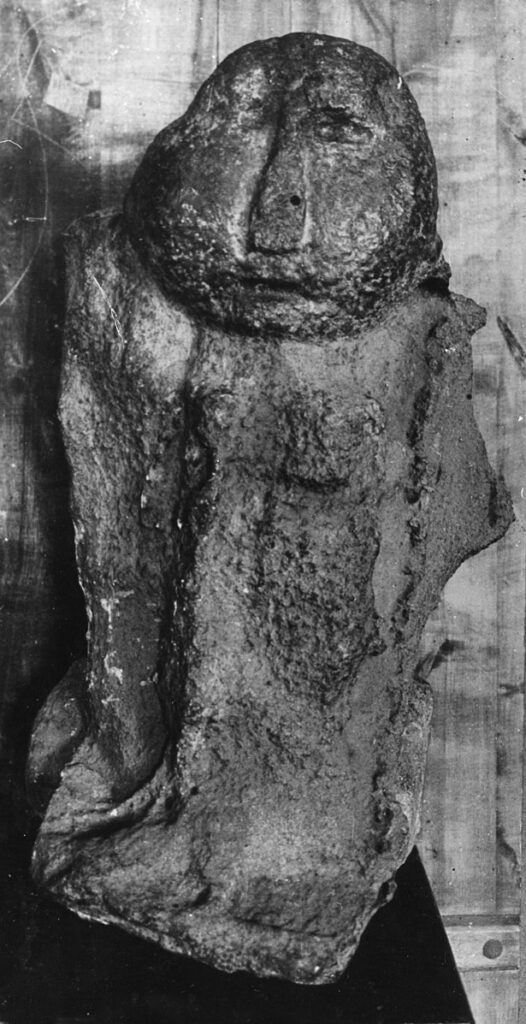
A stone baba (ritual statue) discovered in 1897 between the Promierzyca stream and a factory near Pskov.
Funerary Urn from Biała
The symbol known as the Hands of God originates from a burial urn discovered in 1936 at an archaeological site in Biała, Łódź Voivodeship, dated to the 3rd–4th century CE (Przeworsk culture).
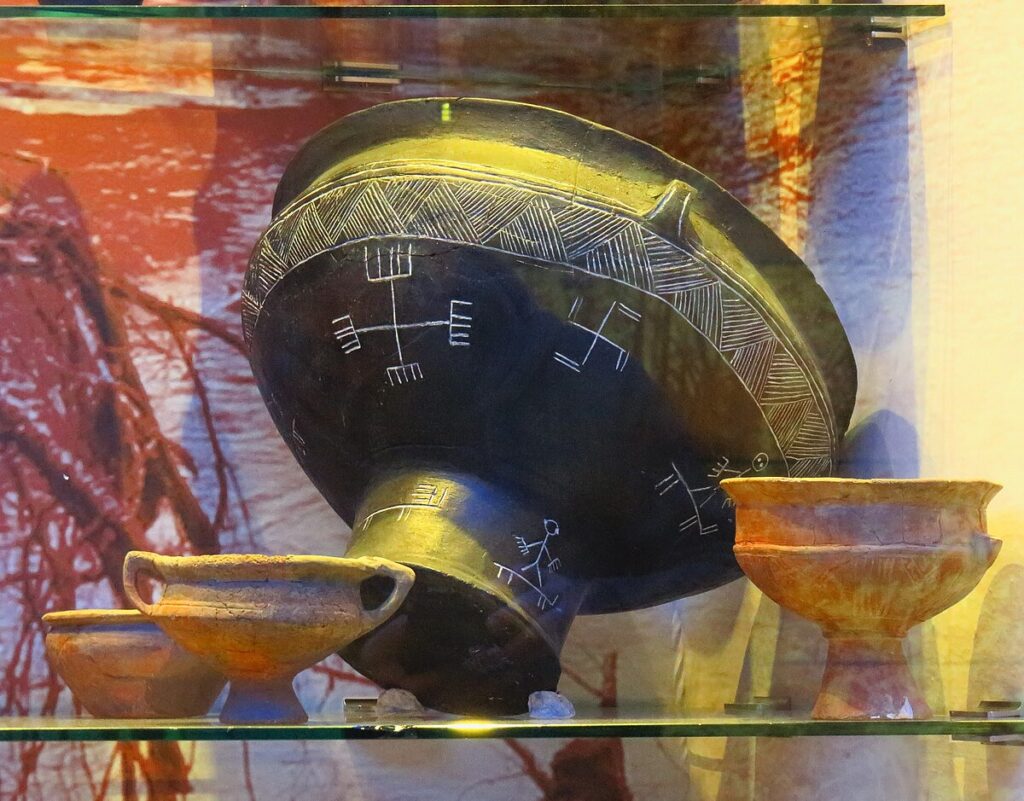
During World War II, due to the presence of swastikas on it, the urn was used by the Nazis for propaganda purposes. Its image was widely reproduced on posters, postcards, and newspapers, and the double-armed swastika became the emblem of the occupied city. The urn disappeared during the German retreat from Łódź and is known today only from a plaster cast.
Polish Royal Insignia
Poland is the only European country with a monarchical past that lacks its coronation regalia—crowns, orbs, and scepters. What happened to them?
The looting of Kraków began in June 1794, immediately after Prussian forces occupied the city. Churches, state offices, and Wawel Castle were ransacked.
Over 120 items were stolen, including the most valuable:
- The so-called Crown of Chrobry, used for the coronation of most Polish monarchs since Władysław Łokietek. It was a solid gold Gothic crown made up of 9 segments adorned with lilies, weighing around 1.3 kg, and decorated with over 300 precious stones and 80 pearls.
(Focus, Crown Jewels of Polish Kings—Where Are They?, 2012)
The crown that Bolesław I Chrobry and his son Mieszko II Lambert were crowned with in 1025 was taken from Poland to Germany in 1031. It was given to Emperor Conrad II and then lost. One hypothesis suggests that in 1075, it was passed to the Czech King Vratislaus II.
The second crown, made in 1025 for Queen Richeza, was eventually returned to her. After her death, it was placed in her tomb but vanished in 1633 during her reburial at Cologne Cathedral (likely stolen).
Source
Polish Treasures in Sweden
“In Swedish libraries and museums, one can also find invaluable Polish archival materials. Among them is the Statut Łaskiego, a collection of all the laws of the Kingdom of Poland, as well as the oldest known text of Bogurodzica and other religious hymns. Recently, in the collections of our northern neighbors, a long-lost Polish Christmas carol, Jezus Bóg i człowiek w stajence betlejemskiej narodzony (“Jesus, God and Man, Born in the Bethlehem Stable”), was rediscovered. A highlight of the permanent exhibition is the helmet of Tsar Ivan the Terrible, which he wore during his coronation. How did it end up in Sweden? First, it was taken by the Poles from the Kremlin in 1612, and later, after being brought to Warsaw, it was seized by the Scandinavians. The most fascinating artifacts are personal items related to Polish monarchs, such as the hunting horn of King Sigismund III, said to have been made from the horn of one of the last aurochs that lived in the forests of Mazovia.” — https://ciekawostkihistoryczne.pl/2018/09/25/bezcenne-polskie-skarby-ktorych-nie-zobaczysz-nad-wisla-mozna-je-podziwiac-tylko-w/
I personally saw in Uppsala the first edition of On the Revolutions of the Celestial Spheres by Copernicus, with his own handwritten notes.
Statue of Perun from Vilnius
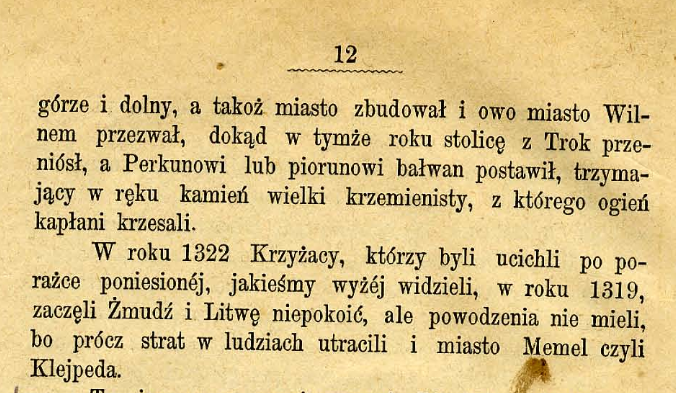
Erected around 1200s; From Lithuania Until the Union of Lublin, Poznań, 1876, Public Library in Lublin.
Source
Perun on a Tray
“In 1684, in the ruins of an old building near Vitebsk, a large golden statue of Perun standing on a tray was found. Many profited from the discovery, and even the Pope received a portion of the gold,” wrote A. M. Sementowski in Antiquities of Belarus (1890).
Perun deity from Kiev
“And Vladimir began to rule alone in Kyiv. And he erected statues outside the palace courtyard [beyond the princely stronghold]: a wooden statue of Perun, with a silver head and a golden mustache; and of Khors, and Dazhbog, and Stribog, and Simargl, and Mokosh.”
— Aleksander Gieysztor, Mythology of the Slavs, University of Warsaw Press, 2006
Szczerbiec
The Szczerbiec is the legendary and historical sword used in the coronation ceremonies of Polish kings. Tradition says that Bolesław Chrobry struck it against the Golden Gate of Kyiv, chipping the blade.
This custom was symbolic among medieval conquerors, and the sword, known as Szczerbiec, became a national relic, used for the coronation of five kings from the Piast dynasty. However, during the reign of Wenceslaus of Bohemia, the coronation insignia were lost.
— Zygmunt Gloger, Old Polish Encyclopedia, 1900
The Belarusian Cross
For the Belarusian people, the most precious lost treasure is the Cross of Euphrosyne of Polotsk, crafted in 1161 by jeweler Bohsham (Lazarus) for the Church of the Savior in Polotsk.
Considered the greatest monument of Belarusian art, it also holds Christian relics—drops of Christ’s blood, wood from the Holy Cross, and other sacred items sent to Polotsk from Constantinople and Jerusalem.
During World War II, the cross disappeared. Initially, only enthusiasts searched for it, but now the Belarusian government and Interpol are involved in its recovery.
— Ivan Savierčanka, Źmicier Sańko, 150 Questions and Answers on the History of Belarus
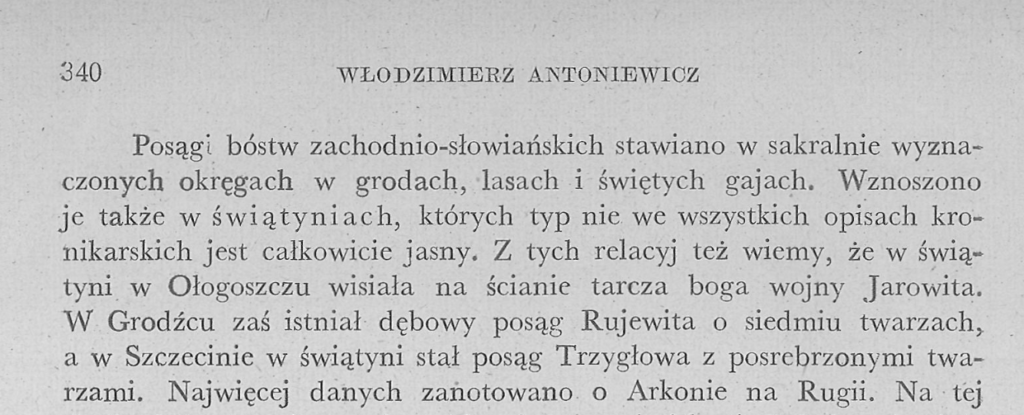
Yarovit Shield and other deities
There was also a Yarovit god shield in Ołogoszcz and an oak Ruyevit deity in Grodziec temple.
Other
In German literature, one can also come across rather laconic information about “pagan idols.” One of them was said to originate from Żydowo near Koszalin and was kept in a private collection. The other was found in the town of Żerzyn and was stored in a museum in Resko. Unfortunately, we were unable to obtain any further details or images of these artifacts. —Religia Pomorzan we wczesnym średniowieczu, Kamil Kajkowski, Andrzej Kuczkowski, 2010
This is not a full list of lost and stolen Slavic artifacts and archeological finds from Slavic countries. It’s just what one person can dig up in free time.
.