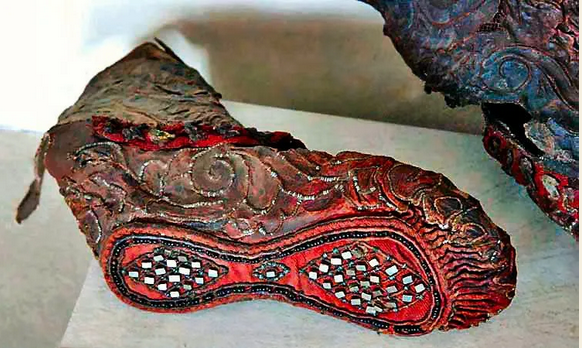
Recently, in the Altai region of Russia, a Scythian shoe from 2300 years ago was found preserved in ice, which I am sharing for now as a curiosity until I come across something super interesting regarding Slavic shoes.
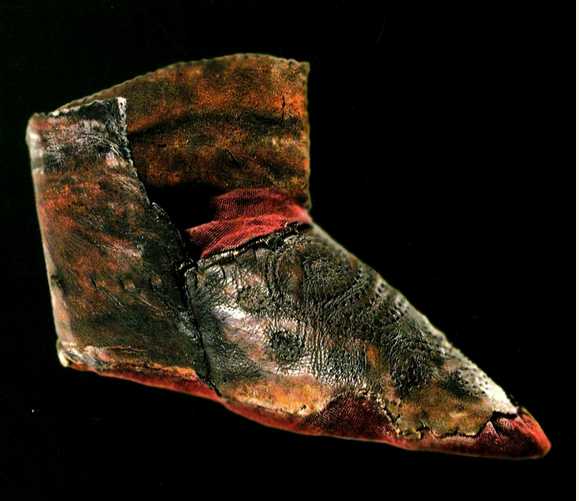
A Slavic Cinderella’s shoe? Rather of a wealthy owner from the 12th century. Look at how it’s decorated with embroidery on the tip. Such footwear distinguishes Eastern Slavs from the Proto-Polish tribes – in terms of cut and decoration. Interestingly, both men and women wore such shoes, so they were “unisex.” This particular specimen spent 800 years in the mud of Polotsk, Belarus before being rediscovered by archaeologists.” – from: Drzewo Przodków / Facebook.
Jewelry made of coins
Dirhams, which were brought to Polish lands as payment for slaves, cattle, hides, furs, honey, or amber, were often not treated as money, which is why they remained in use for a very long time – often for 100-200 years or even longer (…). Coins currently found in treasures and graves often served as decorations. With a drilled hole or added loop, they were used as pendants on necklaces or headbands (…). The custom of wearing silver coins persisted until the end of the 19th century in many regions of eastern Poland. Wealthy rural women gladly added silver rubles to their strands of beads for festive attire.
Jolanta M. Ścibior. A group of Arab coins – dirhams found in Trzcianka, Sokółka County, Podlasie Archaeological Notebooks”, 4, 2008, p. [210]-222
When talking to slightly older people, the theme emerges that just a few decades ago hardly anyone had shoes, and if they did, they went to church barefoot and put them on in front of the church or, for example, there was only one pair for several children. We also know this from Konopielka and other literature. Since it has survived until the 20th century, I suspect that it was quite common among the Slavs earlier as well.
See also – grounding in: Health
No panties
Perhaps without going into detail, let’s consider that underwear is an invention of the last century or two, so… In more esoteric Slavic circles the topic of free flow of energy appears. Nowadays strings and synthetic fabric of underwear dig into the body from all sides… Food for thought.
Scarves
In “Chłopi” by Władysław Reymont one of the heroines:
“… took the child out of the blanket (…), wrapped it in a zapaska and went on quickly.”
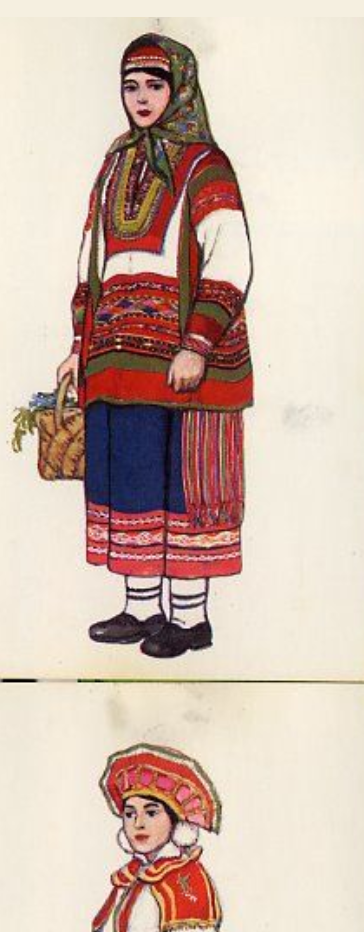
The scarf is a part of many Slavic folk costumes, and we are also familiar with babushkas wearing a scarf. From woolen scarves for the cold, to mountain-style headscarves in churches, to bandanas – scarves accompany Slavic women.
In the olden days a married woman would always cover her hair.
See also in: Hair
Embroidery
“:In folklore embroiding man’s shirt by a woman is a start of marriage. ” Artur Bracki, Słowiańskie powinowactwa kulturowe w kontekście symboli i magicznych przedmiotów utrwalonych w ukraińskich i kaszubskich pieśniach ludowych, Acta Polono-Ruthenica XIII, 2008
Embroidery is an integral part of folk clothing. In the past, it was believed that patterns, stitches, and belts protect their owners on a subtle (invisible) level. Thus, the technology of embroidery is the result of people’s understanding of the order of the world and its harmony. Each clan had its own heraldry, which protected and gave them strength. – writes Tatyana Maslennikova, an artist from Czelabińsk.
Kałamajka, woolen fabric with light-colored stripes. Gentlemen used it for morning gowns, also called dressing gowns, and for back pieces of robes; peasant and townswomen used it for skirts, while peasants used it for waistbands. Due to the similarity in sound, the dance called “kołomyjka” was also known as “kałamajka.”
Zygmunt Gloger, Encyklopedia Staropolska Ilustrowana, Warszawa, 1900-1903
Kibajka
Earrings
On the Lamus Dworski website, an interesting compilation of earrings found at archaeological sites in Poland has been made:
Kontusz
Korale
Kożuch
kożuch, 1938, Poland, polona.pl
“KOŻUCH is our native, Slavic word. Essentially all Slavic languages know it – or knew it. In other Slavic languages and dialects there are more meanings: ‘animal skin’, ‘outer layer’, ‘fruit peel’, and even ‘tree bark’. However, originally KOŻUCH was not a sheepskin, but a goatskin.
The Proto-Slavic word *koža meant ‘skin’ and came directly from another Proto-Slavic word: *koza, which had the same meaning as today, i.e. GOAT.”
How colorful the lace adorns the girls…” – as they used to sing in scouting…
In a local newspaper from Podlasie we read:
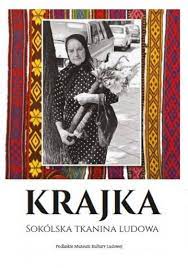
KRAJKA is a narrow strip of woolen material. However, in the villages of Sokólszczyzna, this word is not often used. Instead, we can ask in the local language for “pajas”/”pojas”, which simply means a “belt” for a “shift”. Today, few people remember how interesting and varied were the uses of lace in the villages in the 19th and early 20th centuries.”
Krajka belts are quite common among East Slavs. In Poland they appear in the East – Podlasie and Lubelskie. There are modern artists, who still do them by hand.
Krywulki
rywulki are richly decorated with beads jewelry from Eastern Lemkivshchyna.
Flowers
Łapcie
Łoktusza
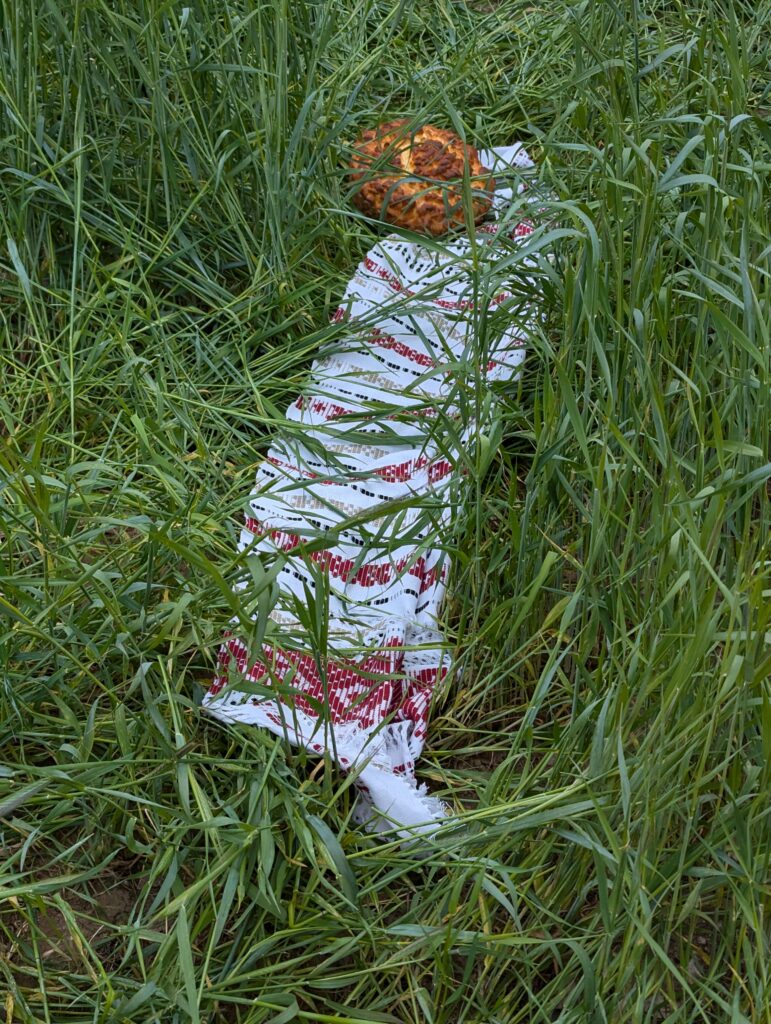
Łoktusza, The old name for a blanket, rańtucha, shawl, which was especially used by women to cover their shoulders and elbows, hence the term łoktusze (elbow coverings), and the shoulder covering was also sometimes called łoktusz. Wacław Potocki best describes the type of use: “She carries the child in the wrapped elbow covering”. A shepherd covered himself with an elbow covering for warmth, as we still see today. The traditional and most beloved colors to the nation were red and white; the first was obtained from an insect called “czerwiec” or from animal blood, and the second through bleaching the fabric in the sun. –
Zygmunt Gloger, Illustrated Old Polish Encyclopedia, Warsaw, 1900-1903.
Belt
Probably since time immemorial people have been wearing belts, and certainly people in Poland and the surrounding areas. For example, such a belt buckle from the 5th century was found in a cave in Ojców.
On the other hand, a rope belt is almost a stereotypical part of the Slavic costume, recognized even by those who are not interested in their history.
Sleeves
I think that knowing what we have read above about the symbolism of embroidery (regional, ritual, ceremonial, etc.), we can assume that in the past, embroideries on sleeves also had meaning for the owner. A girl could embroider protective symbols for her boyfriend, wishes for herself (love, fertility, etc.), or regional motifs.
Rituals with clothing
In the past, newborns were wrapped in their parents’ clothing – a son in his father’s shirt, a daughter in her mother’s shirt, which served as their protection. Until they reached adulthood (which was at 12 years old back then), children wore protective clothing made from their parents’ clothing, filled with their parents’ biofields. It was forbidden to sell one’s own shirt, which is why those who were willing to give away their last shirt were highly valued. All parts of clothing had a magical meaning, the embroidery on the lower part of the garment protected the legs, the ornament at the neck protected the neck and throat, and the patterns on the shirts had their origins in Slavic mythology. The meaning of individual ornaments, their placement, color – all of this adds up to a huge and forgotten knowledge that, hopefully, will begin to return with the development of the consciousness of Slavic nations.
Skirts
Soroczka
“The old granny I met by accident near Krynki [Poland] told me that a fiancee had to make a shirt for her hubby for wedding. That shirt was called sorochka (sorok meaning 40 in Russian) because it required 40 different things to do from sowing flax to ironing. she said: every girl had to know this process. Unfortunately I didn’t record this process. It can be recreated somehow from Maria Konopnicka “Jak to ze lnem było” (how was it with the flax)” — Zygmunt Ciesielski, Tradycyjne Rękodzieło Ludowe Podlasia, 2004
Folk Costumes
I have the following idea for a shop: you provide your region, height, weight, and measurements, and you get your folk costume made in Poland, with embroidery, etc.
Wouldn’t that be a hit?? There could also be a basic option, such as just jewelry and a wreath, an optimal option, and a rich one where everything from head to toe would be included, including shoes, etc.
And here is the best source on Polish folk costumes and their meanings. The author did it so beautifully that it doesn’t make sense for me to copy her, as I couldn’t do it justice.
Pssst… if You absolutely need a costume from certain region in any slavic country, please contact us at bazaslowian###gmail.com and we will be happy to find it for You. If You are not sure wich region would it be, we will try to help as well.
How did Slavs look?
“Prokop, writing in the 6th century AD, says of the Slavs: “All of them use the same language, and they do not differ in physical appearance. Each one is of good height and very strong. Their color is not very white, nor are their hairs very light, although they are never entirely black, but most often somewhat reddish. Their simple minds do not know malice and falsehood.”
Not many people realize that clothing can and should be “alive” and only then becomes a human ally and truly serves them. The name “living clothing” sounds quite complex, but in reality, the word “living” says it all. It is clothing made by a LIVING person, not a machine, and from LIVING, not artificial materials. If, in the production of a specific item, a person puts a part of their soul into it, making it with a certain mood and intention (as women used to do, for example, sewing shirts for their husbands going to war), then the person who wears that item will receive that energy.
Żupan
Żupan (czupan, szupan, ar. dżubba, wł. giuppa), In the costume dictionary, it is defined as trousers with a kaftan, a part of Polish men’s national costume, also worn as an outer garment and at home in the 16th-18th centuries. As mentioned by Irena Turnau, this term was already in use in 14th-century archives (1392).

 Embroidery