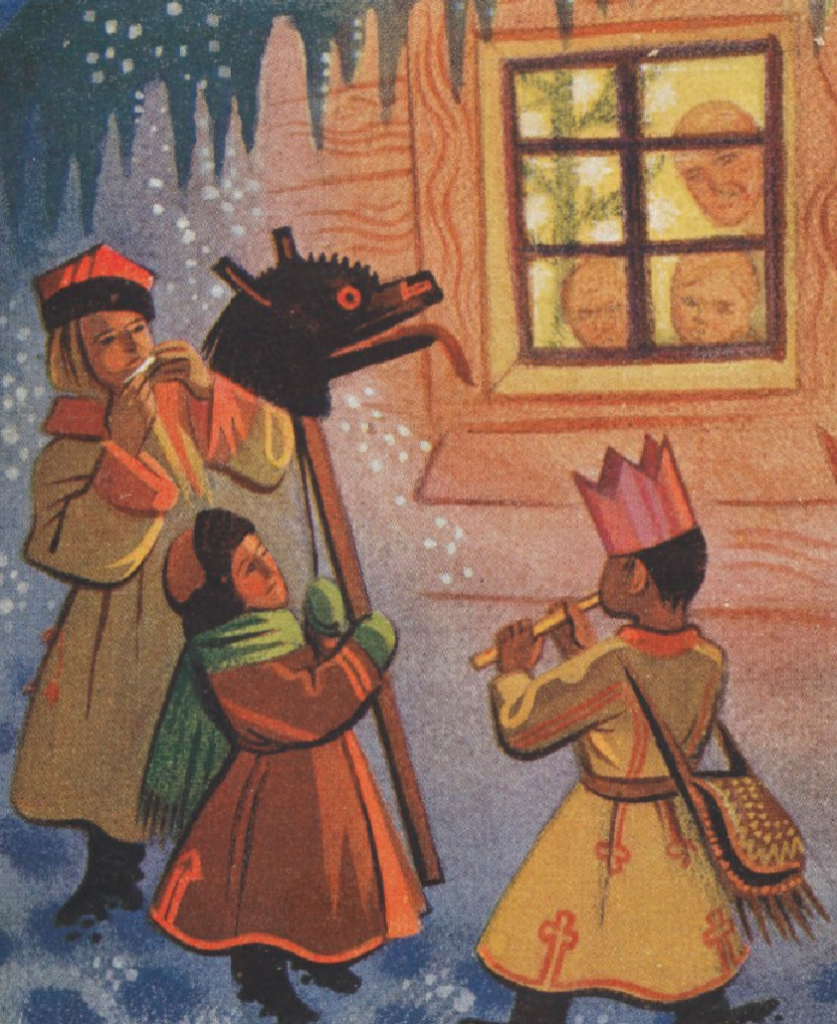
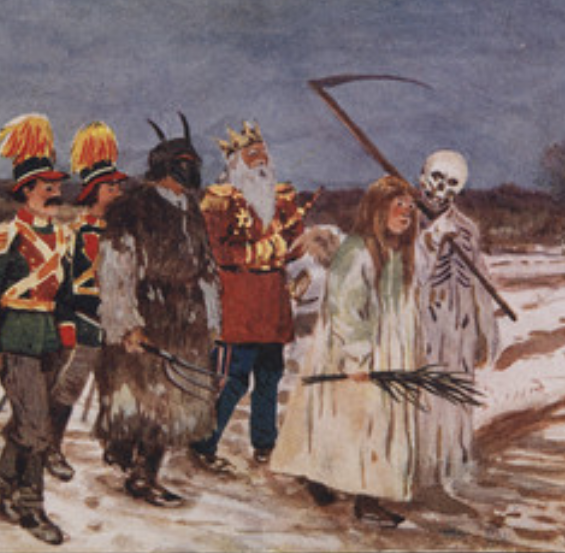
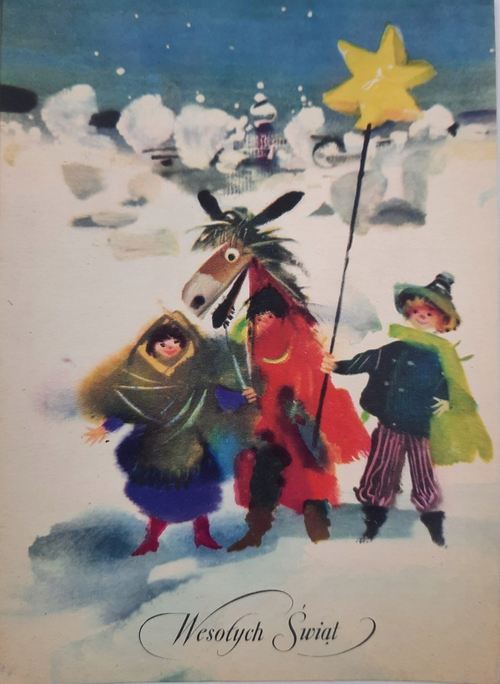
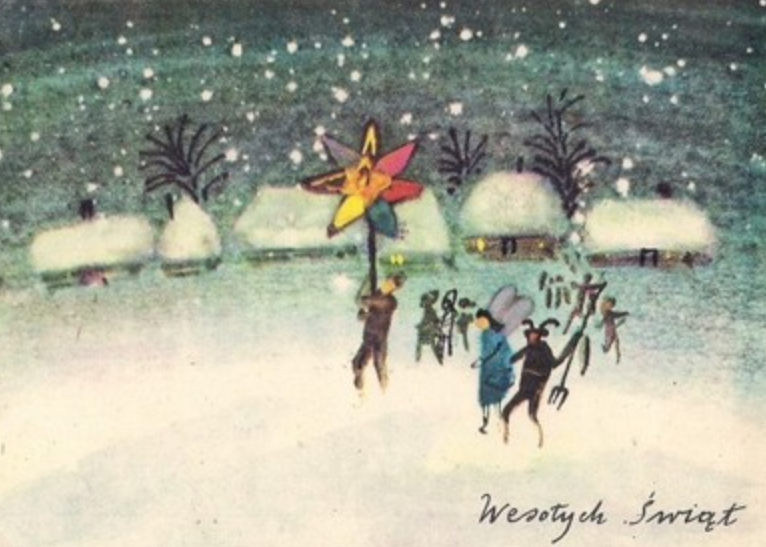
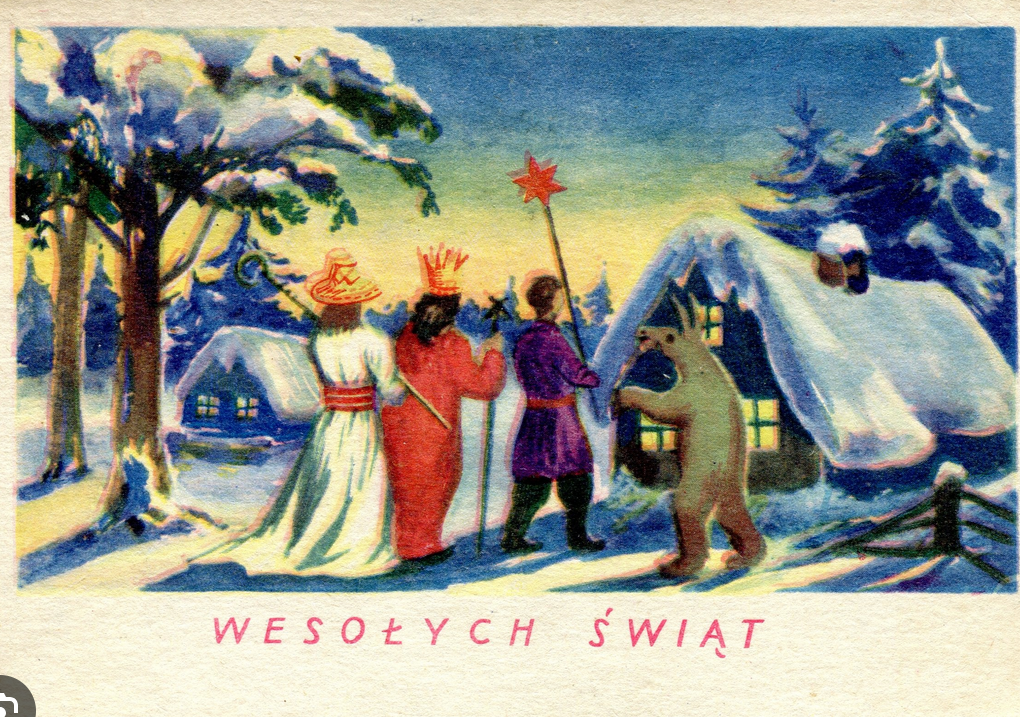
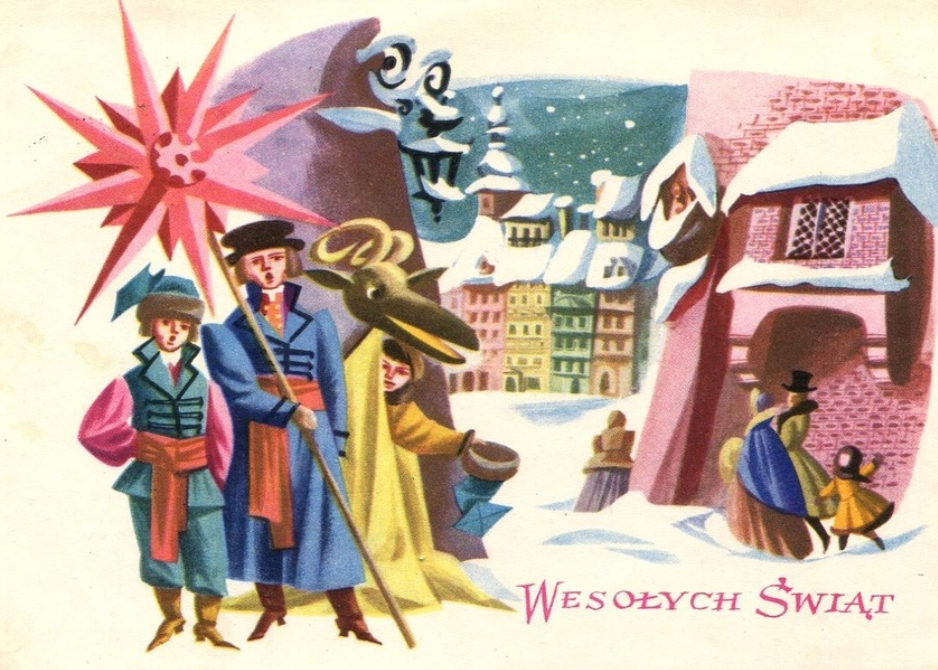
I don’t know if you know, but as recently as 2003, I was in the scouting movement, and around Christmas we would go caroling around the apartment blocks in Bielany, Warsaw. Some time ago, someone pointed out to me that carolers always have a spinning star and… a goat. Actually it is a “turoń” and nobody knows what the heck a turoń is. The rest of the characters are optional and were added later – the devil, the chimney sweeper, the miller, the little angel…
Let’s quote here a Latopis Hustyński, a Russian chronicle from around 1670:
People of Rus were christened and rejected their idols, but till this day they didn’t stop mentioning this Kolada. From the first day of Christmas they gather to play foully, sing songs, where they mention Christmas, but they still can’t forget this Kolada. At this prohibited gatherings they also mention some devilish Tur and other monsters. Other cover their faces (…)
Carolers or Szczodry Wieczór?
At the end of the year Belarusians celebrated Szczodry Wieczór or Koljady, while we in Poland had Szczodre Gody. Last year, for the first time, I learned carols for this occasion – the Szczodry Wieczór survied in old Hutsul songs. When I got home, I also found ‘koljadki’ about Szczodry Wieczór in my grandmother’s songbook from Podlasie.
PS. Szczodry means giving abundantly in Polish. Carol or Carolers is… Kolęda in Polish.
An interesting aspect of these songs was, for example, the mention of taking little fish bones to build a small bridge – to this day, some people take a carp scale from a Christmas table and put it in the wallet, which is believed to bring wealth. Such ‘prosperity ritual’ indeed seems connected to Szczodry Wieczór, but not really to Christmas Eve, does it?
Building small bridges for ancestors was also mentioned in very, very old Rus chronicles as something that peasants do against Churches wishes.
“On Szczodry Wieczór, children received small gifts and nuts, (…) as well as special cakes, usually shaped like animals or dolls, called szczodraki. — Ziółkowka, Maria: Szczodry Wieczór, Szczodry Dzień – obrzędy, zwyczaje, zabawy, Ludowa Spółdzielnia Wydawnicza, Warszawa 1989, s. 207
I once attended Belarusian celebrations of Szczodry Wieczór, where we made masks, and that evening, children made and later handed out little pigs made of dough.
Bogaty Wieczór (Rich Evening) – the day before Christmas Eve, celebrated by the Ruthenians. During this time, the Advent fast was suspended (in regions such as Chełm, the vicinity of Włodawa, Międzyrzec, etc.).
Boże Narodzenie – Nowy Rok (Christmas – New Year) Gody – an old Polish name for the Christmas holidays, covering the period from Christmas Eve to Epiphany.
Like in the Belarussian case Sczodry Wieczór is often mentioned once before the Christmas and for the second time around “Old” New Year.
Szczodry Wieczór in Czechia
The 13th-century monk Jan of Holeszów wrote the treatise Largum Sero, or Szczodry Wieczór (Bountiful Evening), in which he described the Christmas Eve customs of his time.
The culmination of the celebrations was the Christmas Eve supper, preceded by fasting, likely originating from an ancient festival of abundance and prosperity. The meal began at the appearance of the first star in the sky. This was the moment when work and preparations ended, and people sat down at the table.
Jan of Holeszów criticized those who spent this evening indulging in gluttony, drunkenness, and gambling with dice, which was believed to predict fortune or misfortune for the coming year.
(The Church and Folklore in Poland in the 14th and 15th Centuries, Beata Wojciechowska, Kieleckie Studia Teologiczne 13, 151-163, 2014)”
Szczodry Wieczór in Slovakia
In Slovakia, Christmas Eve is called Štedrý večer, and a popular cake similar to our poppy seed roll is called szczodrak, which I read about here. A recipe for it is also included.
Szczodry Wieczór in Ukraine
It is described very interestingly on this blog. The author mentions the old name Babia Wigilia, shares a szczedrywka (a traditional song) about the celebration of the sun, moon, and rain, and highlights the blessing of water and fire in the church. Ukrainians celebrate Szczodry Wieczór in mid-January.
Kolyady in Lithuania
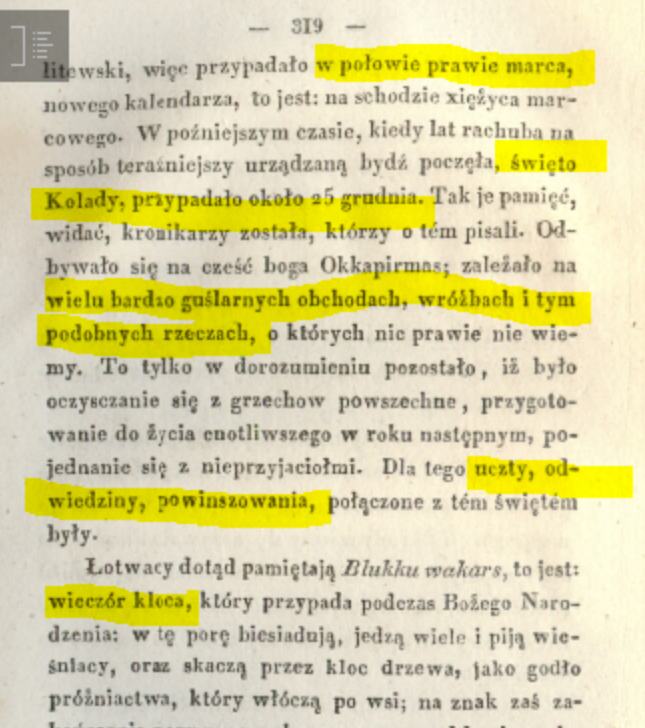
Theodor Narbutt writes in Ancient History of the Lithuanian Nation (1835):
Above he too mentions some kind of a change in the calendar that changed the Koljady date at some point.
And why a goat?
It remains a mystery why the goat or other horned animals are so essential during caroling.
I’ve been thinking about it for the past year and haven’t come up with anything, but in the meantime, I noticed that:
A bull or goat appears in fertility rituals as early as the Neolithic, as can be read about, for example, here.
The Capricorn sign actually starts on December 23…
In ancient Rome, the first day of each month was called Kalenda (hence the word ‘calendar’). After 153 BCE, the first Kalenda of January was also established as the beginning of the year and a holiday. People would visit each other’s homes and celebrate, which is believed to be the ancient origin of Carnival. More here.
Not sure if it has anything to do with any of that, but in old texts it is often mentioned that “furry-ness” (kosmatość) was connected in some way to prosperity and abundance in ancient Slavic beliefs Leonard Pełka mentions for example a new weds sitting on a “very hairy animal skin”. It also comes up in fairytales and folklore.
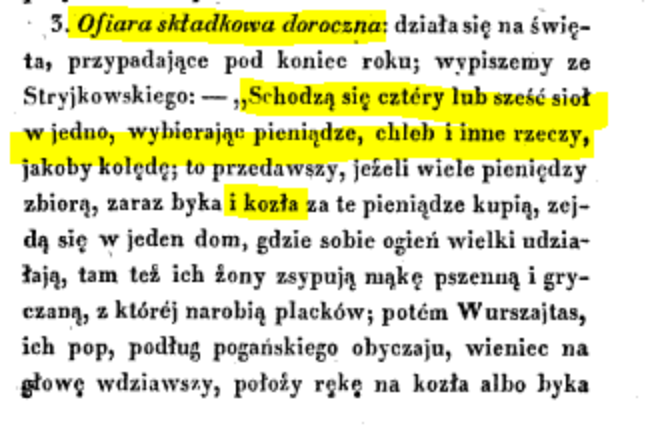
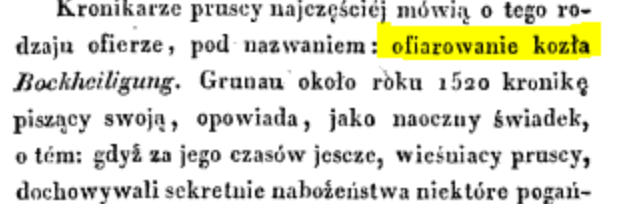
Narbutt writes about the “ancient” customs of Lithuanians in the section on sacrifices:
And the star? I have no idea either. The simplest explanation suggests the story of the Three Kings, but I don’t know – it is clearly a slightly different, stranger, and always spinning star of various colours…