
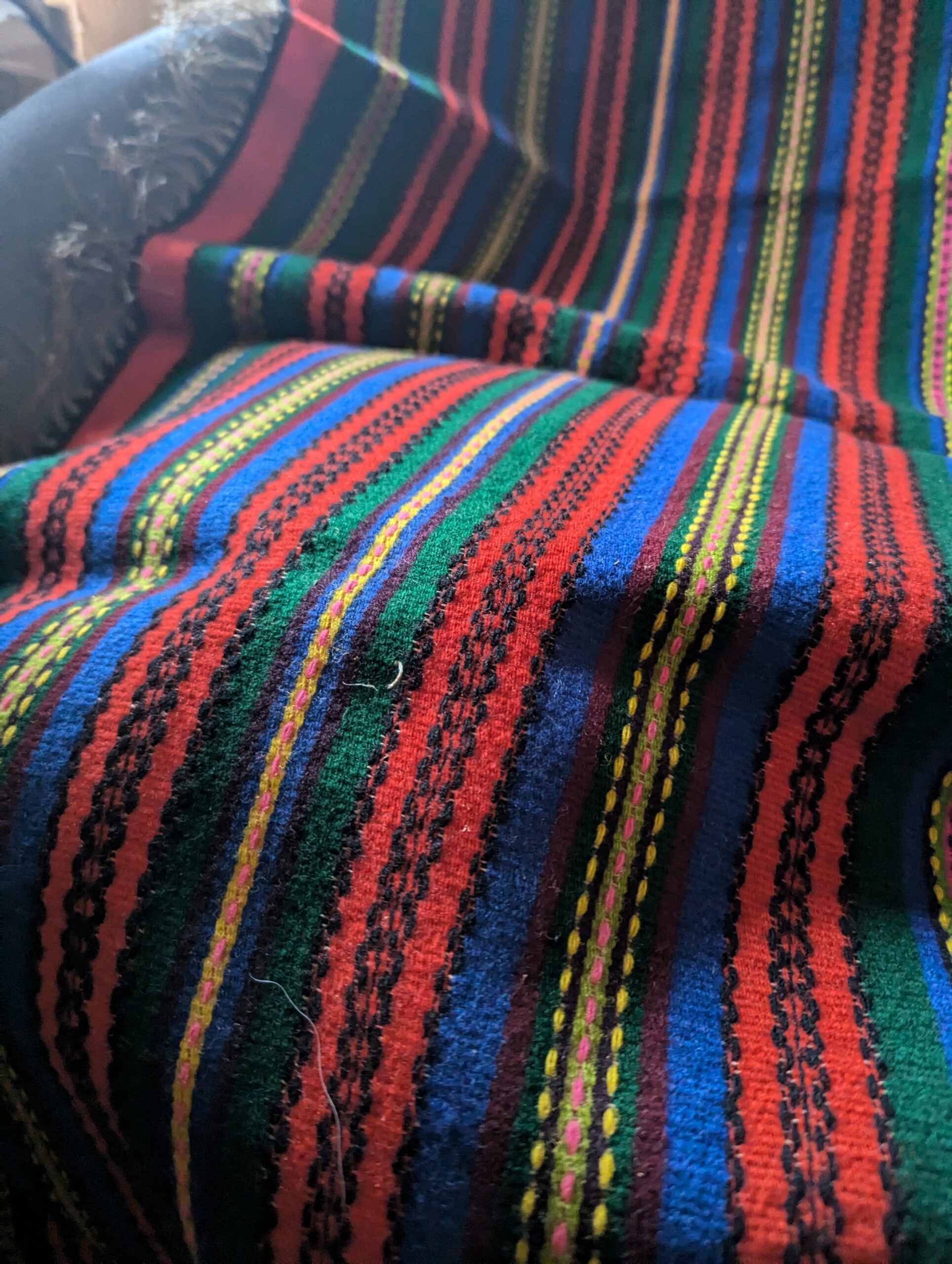
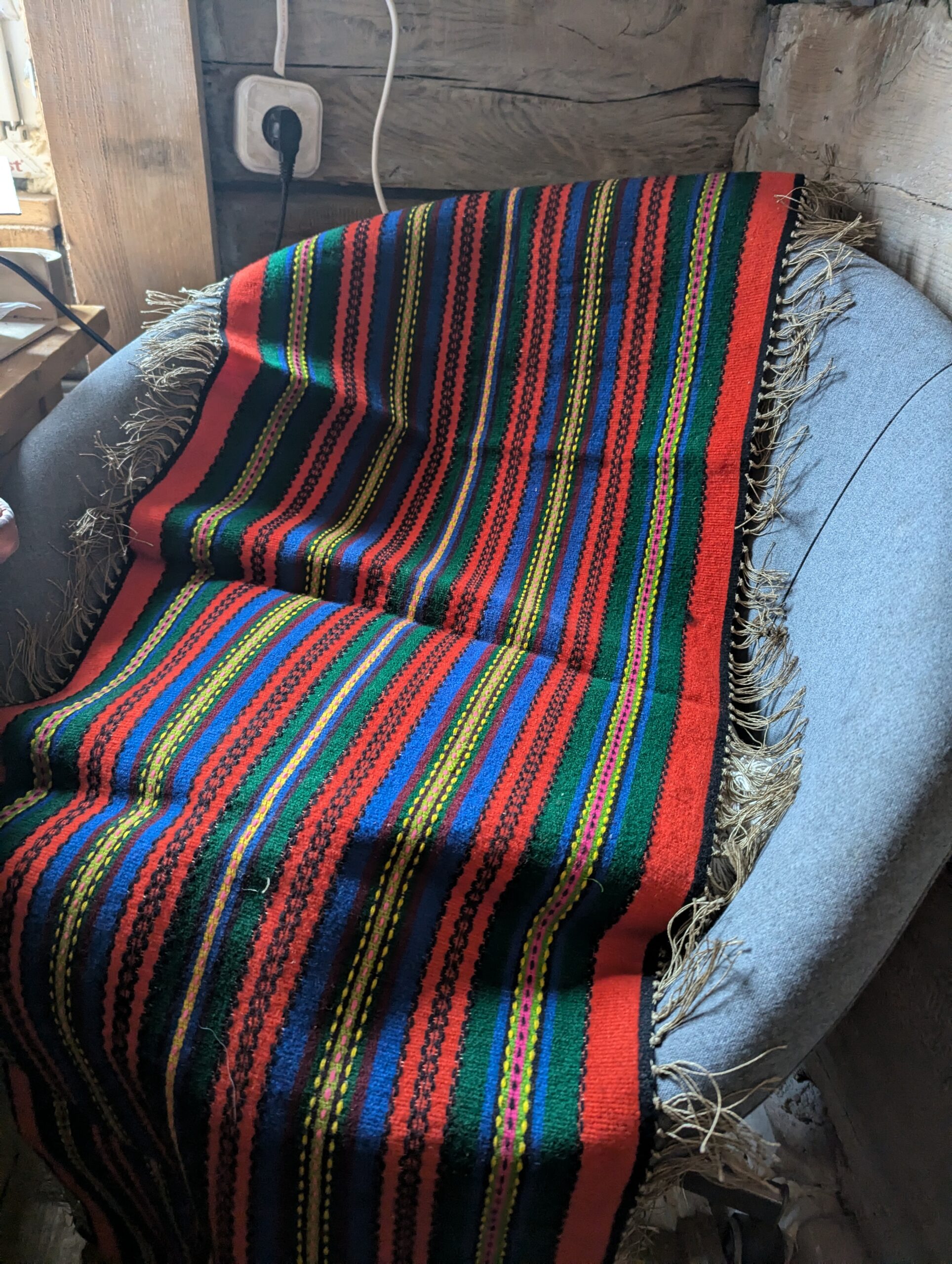
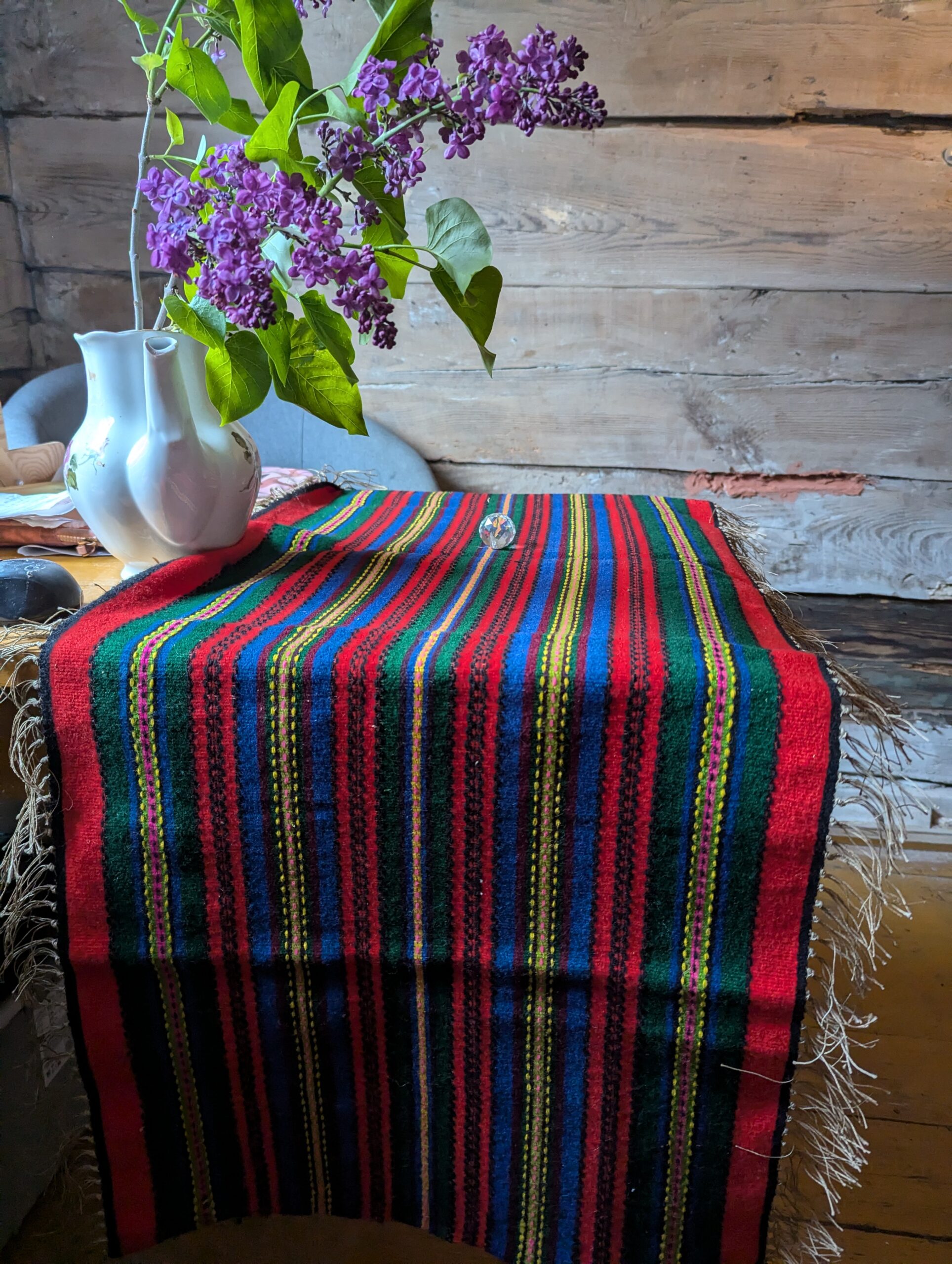
Description
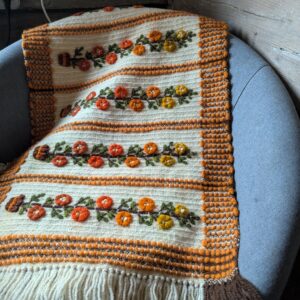
Condition: good with small imperfections like thinned material or uneven rim
size: 46×146 cm
Time: 70s XX c
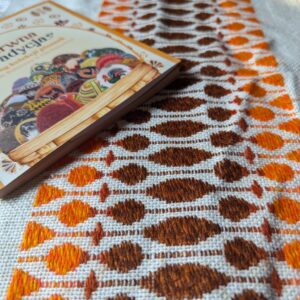
Material: Wool sourced and dyed locally – in Poland:)
Handmade on traditional loom in Central Poland.
Thickness: Medium
Feel: Medium (not so soft but not itchy:)
Softness: Soft
See similar “Pasiaki” on a website of Wroclaw National Museum in Poland:
Striped textiles, where linen warp is most often interwoven with multicolored woolen (but also sometimes linen or cotton) weft, have a long tradition in Poland dating back to the 11th century.
Initially, they were relatively modest, two- or three-colored, with narrow stripes. Currently, the color palette of some striped textiles is very rich, and their distribution encompasses northeastern Poland, Mazovia, northern Lublin region, Kielce region, Opole Silesia, and Sieradz region. They were also known among the Borderland inhabitants (Kresowiacy), and after 1945, they found their way to Lower Silesia with them.
This type of fabric in Poland is characterized by many local variations, differing in the range of colors and their arrangement. For example, the ones from Kielce had quite wide stripes in two or three colors – they could be red-black, black-white, or red-green-navy, sometimes enriched with narrow stripes in other contrasting colors (e.g., yellow). In Podlasie, the dominance of colors in shades of yellow, red, and white was noticeable, while in Lublin region, it was browns, navies, and dark greens. In the textiles of the Rawa-Opoczno region, a typical background was repeated, initially red, then ochre, crimson, or orange; here, materials decorated with stripes made of colorful cubic motifs called “koziołki” were also characteristic. Over time, striped textiles over a significant area were dominated by fabrics with rainbow sets (the number of colors could reach about 30) and are often called “łowickie” or “krakowskie”, although they generally have little in common with authentic striped textiles from Łowicz, and such textiles never occurred around Krakow.
These fabrics were made of mixed materials and mostly are linen-wool with a tabby weave, but sometimes linen-cotton or hemp-cotton. Some were woven only with linen threads in a warp weave. The color palette of the weft in striped textiles is quite rich, especially in those where it is woolen. Then, multicolored transverse, wider or narrower stripes are created, sometimes rhythmically repeating. In some cases, the stripes are two- or three-colored, and such simpler bedspreads were used as everyday bed covers or as sheets, hence sometimes called “pościałki”. The oldest striped textile in the museum’s collections is a bedspread dating back to around 1880 from Volhynia, while most of these fabrics were made in the interwar period.
Immerse yourself in the rich cultural heritage of Eastern Europe with our exceptional Slavic Wool Bedcover.
Reviews
There are no reviews yet.