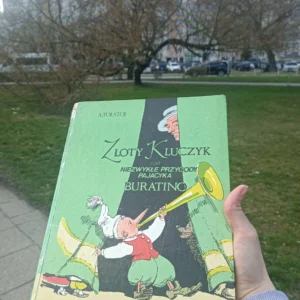
One of books from a sserie about best of Polish Pagan Old Legends – Queen Wendy, King Popiel and such. Vintage Children Books with Stunning Illustrations printed in the 1980s
Condition: Good
Published : 1985
So if You went to Polish school You noticed this: in the primary school its constantly about King Krak, Ancient Queen Wendy who didnt want to merry a German, King Popiel eaten by Mice, Piast Kołodziej and so on. Then they are never mentioned again:D
Source Accounts
King Popiel
For the first time, Popiel appears in the Chronicle of Gallus Anonymous as the ruler of Gniezno. During the tonsuring ceremony of his sons, two mysterious guests arrived in Gniezno, although they were not invited to the feast, thus violating the principle of hospitality. They went to seek hospitality from a poor plowman named Piast, who was also celebrating the tonsuring of his son Siemowit. According to Gallus, Popiel himself was supposed to be present at Piast’s ceremony, as the prince did not consider it beneath him to attend his peasant neighbor’s event. When Siemowit grew up, he was to remove Popiel from the throne and become the new ruler.
Gallus complements his account with a story told by wise elders, claiming that the exiled Popiel was persecuted by mice, and he sought refuge in a wooden tower on an island. There, he was supposedly devoured by the mice.
Popiel II in Wincenty Kadłubek’s Chronicle
Wincenty Kadłubek, in his Chronicle, expanded the legend of Popiel (whom he called Pompiliusz II), making him the son of Popiel I and the grandson of Leszek III. According to Kadłubek, Popiel was a lazy, cowardly, effeminate, and treacherous ruler. At the instigation of his wife, he poisoned his twenty uncles (sons of Leszek III) by serving them poisoned wine during a feast and then refused to bury their bodies. Mice emerged from the corpses and chased Popiel, his wife, and two sons for a long time. Eventually, they caught up with them hidden in a tall tower, where they were devoured.
Popiel II in the Greater Poland Chronicle
According to the Greater Poland Chronicle, Popiel, due to his long hair, was nicknamed Chościsko, meaning a worn-out and wretched broom (according to Gallus Anonymous, Piast’s father also bore this name). The Greater Poland Chronicle also mentions Mysia Wieża (Mouse Tower) in Kruszwica as the place of the ruler’s death, a detail repeated in the Polish-Silesian Chronicle and the Chronicle of Polish Princes. In reality, however, this tower was built by Casimir the Great.
Popiel II in Later Chronicler
.
Historicity of Popiel
Those who accept the historicity of Mieszko I’s three predecessors – Siemowit, Lestek, and Siemomysł – usually also accept the historicity of Popiel. However, a problem arises from new archaeological and dendrochronological findings. Popiel could not have resided in the Gniezno stronghold, as the Gniezno stronghold was built around 940 AD, and Popiel’s rule probably occurred in the second half of the 9th century. The contemporary Popiel Piast is associated with the existing Giecz stronghold from the second half of the 9th century. It could be that Popiel resided in an unknown tribal stronghold in the Gniezno region, yet was ideologically linked to the cult center on Góra Lecha in Gniezno, explaining Gallus Anonymous’s association with Gniezno. As archaeology indicates, during the times of Popiel and Siemowit, there were no strong economic-military foundations for princely power, allowing for the construction of state strongholds by the population under the supervision of a coercive apparatus, i.e., the drużyna. Popiel probably failed to properly redistribute surplus production among the members of his community, leading to his replacement by the more promising Siemowit.”


Reviews
There are no reviews yet.